

Narrow-Leaved Mock Privet
phillyrea angustifolia
The Narrow-Leaved Mock Privet is a resilient and versatile evergreen shrub native to the sunny landscapes of the Mediterranean basin. Belonging to the olive family, Oleaceae, this plant is well-adapted to surviving the intense heat and dry summers characteristic of its native habitat. It plays a crucial role in its ecosystem by providing dense cover for nesting birds and a reliable source of food for various insects and small mammals. Its deep roots help stabilize soils in dry, erosion-prone areas.
Lebensraum: Found in dry, sunny scrublands, garrigues, coastal cliffs, and open pine woodlands across the Mediterranean basin.
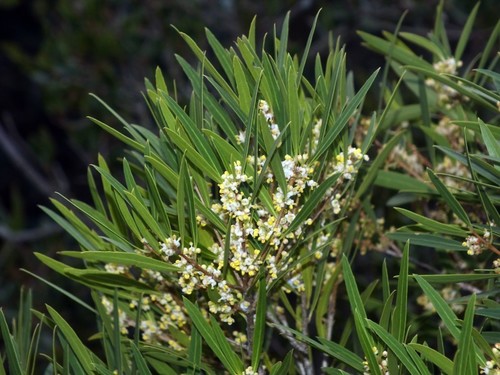
This species forms a dense, bushy shrub typically growing between 1 to 3 meters in height. It features narrow, linear-to-lanceolate leaves that are opposite, leathery, and dark green with smooth, entire margins. In spring, it produces clusters of tiny, fragrant, pale yellow-green flowers nestled in the leaf axils. These flowers develop into small, round, fleshy drupes that ripen to a shiny blue-black color, closely resembling miniature olives.
Kategorie
PflanzenSeltenheit
Common
Gefahr
1/5 · Sehr gering
Snaps
Mach den ersten Snap!
Historically, its leaves have been used in traditional folk medicine for their astringent properties to treat inflammation.
It is a close wild relative of the commercial olive tree, sharing a very similar wood structure and leaf arrangement.
Its incredibly dense twig structure makes it a preferred nesting site for small, secretive Mediterranean songbirds.
Features thick, leathery leaves covered in a waxy cuticle that drastically reduces water loss during scorching summer droughts.
Can rapidly resprout from its basal root crown after devastating wildfires, allowing it to quickly reclaim its habitat.
Possesses a high tolerance to airborne salt and strong coastal winds, enabling it to thrive in rugged seaside environments.
As a plant, it produces its own energy via photosynthesis, converting sunlight, water, and carbon dioxide into sugars.
Sylvia atricapilla
The blackcap feeds on the dark berries during autumn and aids in seed dispersal.
Apis mellifera
Honey bees visit the highly fragrant flowers in spring to collect nectar and pollen.
Oryctolagus cuniculus
Rabbits browse on the low-hanging evergreen leaves and young twigs during dry seasons.
Für dieses Objekt sind noch keine Merkmal-Badges vergeben.
Noch keine Alternativnamen vorhanden.
Sammlungen für dieses Objekt erscheinen hier, wenn weitere Themen hinzugefügt werden.
Gefahr
1/5 · Sehr gering
Noch keine besonderen Sicherheitshinweise.
Der einfachste Weg, Narrow-Leaved Mock Privet zu bestimmen, ist die Verwendung der Naturführer-App Snappit.
100-300 cm
50-150 Jahre
As a plant, it produces its own energy via photosynthesis, converting sunlight, water, and carbon dioxide into sugars.
Found in dry, sunny scrublands, garrigues, coastal cliffs, and open pine woodlands across the Mediterranean basin.
Zoome hinein, um Cluster aufzulösen und zu sehen, wo dieses Objekt fotografiert wurde.
Neueste Snaps erscheinen hier, wenn neue Beobachtungen hinzukommen.