

Northern Comandra
geocaulon lividum
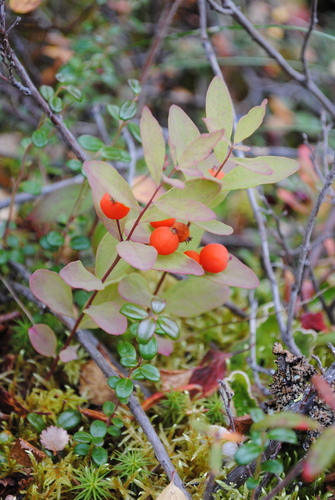
Northern Comandra (Geocaulon lividum), also known as false toadflax, is a fascinating perennial herb native to the northern boreal forests. While it possesses green leaves and performs photosynthesis, this clever understory plant is actually a hemiparasite. It stealthily taps into the root systems of neighboring trees and shrubs, such as black spruce and blueberries, to steal water and vital nutrients. This dual-survival strategy allows it to thrive in nutrient-poor, acidic soils where other plants struggle. Beyond its parasitic lifestyle, Northern Comandra plays an important role in its ecosystem. In late summer, it produces bright, fleshy orange-to-red drupes that stand out vividly against the mossy forest floor, providing a valuable food source for local birds and small mammals.
Lebensraum: Typically found in acidic soils of boreal coniferous forests, muskegs, bogs, and subalpine woodlands.
Northern Comandra is a low-growing perennial herb standing between 10 to 30 centimeters tall. It features simple, alternate, oval-shaped leaves that are smooth-edged and have a somewhat leathery texture, often turning a bronzy or purplish-green hue. Its flowers are tiny, inconspicuous, and brownish-purple, clustering in the leaf axils. The most striking visual identifier is its single, fleshy, bright orange or scarlet-red round fruit (drupe) that sits nestled at the base of the upper leaves during late summer and autumn.
Kategorie
PflanzenSeltenheit
Common
Gefahr
1/5 · Sehr gering
Snaps
Mach den ersten Snap!
Although it is a green, photosynthetic plant, Northern Comandra cannot survive long-term or reproduce successfully without a host plant to parasitize.
Its scientific genus name, Geocaulon, translates to 'earth-stem' in Greek, referring to its creeping underground rhizomes.
The single fleshy orange-red fruit is edible to humans, though it is described as having a very mild, watery, and slightly sweet flavor.
Utilizes specialized underground structures called haustoria to attach to and siphon water and nutrients from the roots of neighboring host plants.
Combines active photosynthesis in its green leaves with parasitic extraction, enabling survival in highly nutrient-depleted soils.
Thrives in highly acidic conditions of peat bogs and coniferous understories that would stunt or kill less specialized plant species.
As a hemiparasitic plant, it produces its own energy via photosynthesis while stealing water and mineral nutrients from the roots of host plants.
Altersunterschiede: Seedlings rely on seed reserves before developing haustoria to parasitize host roots and beginning photosynthesis.
Picea mariana
Serves as a host tree from which Northern Comandra steals water and nutrients via its roots.
Betula glandulosa
Acts as another common deciduous host shrub parasitized by Northern Comandra roots.
Falcipennis canadensis
Feeds on the bright orange-red drupes of the Northern Comandra, assisting in seed dispersal.
Für dieses Objekt sind noch keine Merkmal-Badges vergeben.
Noch keine Alternativnamen vorhanden.
Sammlungen für dieses Objekt erscheinen hier, wenn weitere Themen hinzugefügt werden.
Gefahr
1/5 · Sehr gering
Noch keine besonderen Sicherheitshinweise.
Der einfachste Weg, Northern Comandra zu bestimmen, ist die Verwendung der Naturführer-App Snappit.
10-30 cm
0.01-0.05 kg
3-15 Jahre
As a hemiparasitic plant, it produces its own energy via photosynthesis while stealing water and mineral nutrients from the roots of host plants.
Typically found in acidic soils of boreal coniferous forests, muskegs, bogs, and subalpine woodlands.
Zoome hinein, um Cluster aufzulösen und zu sehen, wo dieses Objekt fotografiert wurde.
Neueste Snaps erscheinen hier, wenn neue Beobachtungen hinzukommen.

Alaska, US
Hier kann man sehen Kanadischer Hartriegel und Felsenbirne.
Führer anzeigen →

Alaska, US
Hier kann man sehen Elch, Amerikanisches Rothörnchen und Preiselbeere.
Führer anzeigen →
















