

Northern Ground-Cedar
diphasiastrum complanatum
Northern Ground-Cedar is an ancient vascular plant belonging to the clubmoss family. Often mistaken for miniature conifer seedlings, this evergreen perennial creeping plant adds a touch of primeval charm to the forest floor. It spreads through horizontal underground stems (rhizomes), from which fan-shaped, flattened vegetative branches arise. Because of its resemblance to cedar bows, it has long been appreciated for its aesthetic and decorative value, though it is actually a lycophyte—a lineage of plants that predates modern seed plants by millions of years. This species plays an important role in boreal and montane forest ecosystems, binding soil and providing microhabitat for tiny invertebrates.
Lebensraum: Found in dry to moist boreal forests, acidic woodlands, and mountainous pine barrens, often growing among mosses and ericaceous shrubs.
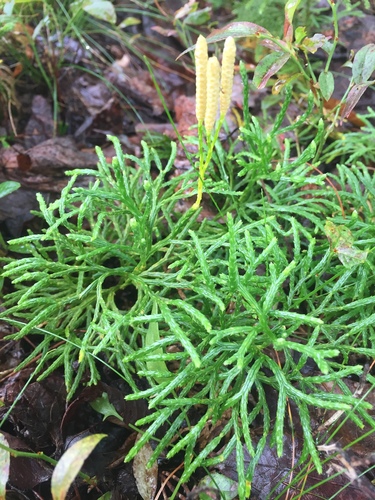
This plant is easily recognized by its flattened, yellowish-green branchlets that branch dichotomously, spreading out like tiny cedar fans. The scale-like leaves are tightly appressed to the stems in four distinct ranks. In late summer, upright, branched stalks emerge bearing yellow-brown, cone-like structures called strobili, which release dust-like spores. The entire plant typically reaches a height of 10 to 30 centimeters, while its creeping runners can stretch several meters along the forest floor.
Kategorie
PflanzenSeltenheit
Common
Gefahr
1/5 · Sehr gering
Snaps
Mach den ersten Snap!
Because the spores are highly hydrophobic (water-repellent), coating your hand in them allows you to dip it into water and pull it out completely dry.
Lycopodium powder, made from the dry spores of this and related clubmoss species, was used as the very first photographic flash powder.
The underground gametophyte generation of this plant can live entirely in the dark for up to 15 years, relying completely on symbiotic fungi before producing the green shoots we see.
The spores contain a very high oil content, making them highly flammable; they were historically used as flash powder in early photography and theatrical effects.
It propagates vegetatively through underground rhizomes, allowing a single genetic individual to spread and survive for decades across the forest floor.
Its specialized scale-like leaves retain moisture and chlorophyll through freezing winters, allowing it to begin photosynthesis immediately in early spring.
As a photosynthetic plant, Northern Ground-Cedar produces its own energy using sunlight, water, and carbon dioxide.
Picea mariana
Creates the acidic, shaded forest floor conditions and needle litter necessary for the ground-cedar to thrive.
Glomus intraradices
Nourishes the underground, non-photosynthetic gametophyte stage of the ground-cedar via mycorrhizal associations.
Für dieses Objekt sind noch keine Merkmal-Badges vergeben.
Noch keine Alternativnamen vorhanden.
Sammlungen für dieses Objekt erscheinen hier, wenn weitere Themen hinzugefügt werden.
Gefahr
1/5 · Sehr gering
Noch keine besonderen Sicherheitshinweise.
Der einfachste Weg, Northern Ground-Cedar zu bestimmen, ist die Verwendung der Naturführer-App Snappit.
10-100 cm
10-100 Jahre
As a photosynthetic plant, Northern Ground-Cedar produces its own energy using sunlight, water, and carbon dioxide.
Found in dry to moist boreal forests, acidic woodlands, and mountainous pine barrens, often growing among mosses and ericaceous shrubs.
Zoome hinein, um Cluster aufzulösen und zu sehen, wo dieses Objekt fotografiert wurde.
Neueste Snaps erscheinen hier, wenn neue Beobachtungen hinzukommen.