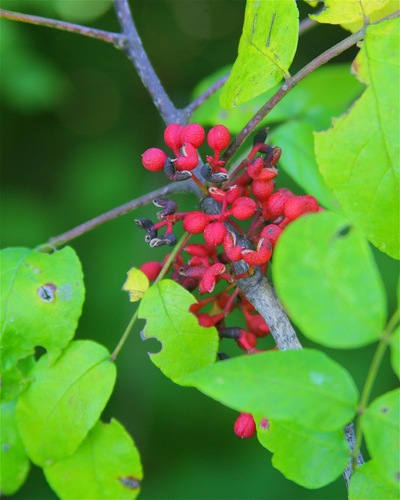


Northern Prickly Ash
zanthoxylum americanum
The Northern Prickly Ash (Zanthoxylum americanum) is a fascinating, aromatic shrub native to North America. Despite its common name and ash-like pinnate leaves, it is not a true ash at all, but rather a member of the citrus family (Rutaceae). This understory specialist is historically famous for its medicinal qualities, particularly its ability to alleviate toothaches. When any part of the plant—especially the bark or leaves—is chewed, it releases active chemical compounds that induce a powerful tingling and numbing sensation in the mouth.
Lebensraum: Typically found in moist or rocky open woodlands, forest edges, thickets, and along riparian corridors.
This deciduous shrub typically grows between 150 to 500 centimeters tall, forming dense, multi-stemmed thickets. Its most defining physical features are the sharp, dark-brown prickles paired at the bases of its pinnate compound leaves, which consist of 5 to 11 ovate leaflets. In spring, before the leaves fully expand, it produces small, inconspicuous yellow-green flowers. By late summer, these develop into small, clustered, bumpy reddish-brown seed capsules that split open to reveal shiny black seeds, all while emitting a strong, citrusy aroma when crushed.
Kategorie
PflanzenSeltenheit
Common
Gefahr
1/5 · Sehr gering
Snaps
Mach den ersten Snap!
Because it belongs to the citrus family (Rutaceae), its leaves contain oil glands that emit a fragrant, lemon-like scent when bruised.
Native Americans and early European pioneers chewed the bark of this plant to relieve severe toothaches, leading to its famous nickname, the 'Toothache Tree'.
While most mammalian browsers avoid it due to the sharp prickles and numbing chemicals, it is highly sought after by specialized lepidopteran larvae.
Produces secondary metabolites like herculin in its bark and leaves, which numb oral tissues to deter mammalian herbivores.
Glands on the leaves secrete highly aromatic essential oils that repel destructive pests while attracting specific pollinators.
Possesses sharp, flat-based thorns along its twigs and petioles that physical protect the shrub from larger browsers.
As a photosynthetic plant, it manufactures its own sugars using sunlight, water, and carbon dioxide, while absorbing minerals through its root system.
Papilio cresphontes
Serves as a vital host plant for caterpillars of Canada's largest butterfly.
Apis mellifera
Feeds on the small yellow-green spring flowers to harvest nectar.
Turdus migratorius
Consumes the ripe red berries in late autumn and disperses the seeds.
Für dieses Objekt sind noch keine Merkmal-Badges vergeben.
Noch keine Alternativnamen vorhanden.
Sammlungen für dieses Objekt erscheinen hier, wenn weitere Themen hinzugefügt werden.
Gefahr
1/5 · Sehr gering
Noch keine besonderen Sicherheitshinweise.
Der einfachste Weg, Northern Prickly Ash zu bestimmen, ist die Verwendung der Naturführer-App Snappit.
150-500 cm
15-50 Jahre
As a photosynthetic plant, it manufactures its own sugars using sunlight, water, and carbon dioxide, while absorbing minerals through its root system.
Typically found in moist or rocky open woodlands, forest edges, thickets, and along riparian corridors.
Photosynthesis
Zoome hinein, um Cluster aufzulösen und zu sehen, wo dieses Objekt fotografiert wurde.
Neueste Snaps erscheinen hier, wenn neue Beobachtungen hinzukommen.