

Old World Webworm
hellula undalis
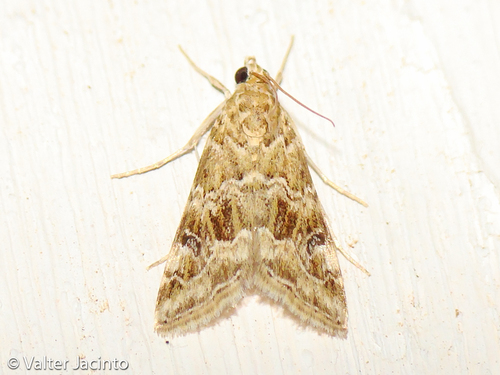
The Old World Webworm (Hellula undalis), also widely known as the cabbage webworm, is a small moth belonging to the family Crambidae. Though the adults are modest and easily overlooked, their larvae are notorious in agricultural circles as highly specialized herbivores with a strong preference for plants in the brassica family, such as cabbage, broccoli, and radishes. This species is highly adaptable and thrives in warm, temperate, and tropical climates across Europe, Asia, Africa, and Australia. What makes the Old World Webworm fascinating is the larval survival strategy. They construct intricate silk webs over their feeding zones, which act as a protective fortress shielding them from environmental hazards, predators, and even chemical controls, making them remarkably resilient in their habitats.
Lebensraum: Found in agricultural fields, vegetable gardens, and cultivated croplands where cruciferous plants are grown.
The adult Old World Webworm is a small moth with a wingspan of 1 to 2 centimeters. Its forewings are mottled grayish-brown, decorated with distinctive wavy, undulating pale-brown and dark-brown bands, while the hindwings are a uniform pale grayish-white. In its larval stage, the caterpillar is easily recognized by its creamy-yellow body adorned with five prominent, dark-brown longitudinal stripes and a shiny blackish-brown head capsule.
Kategorie
InsektenSeltenheit
Common
Gefahr
1/5 · Sehr gering
Snaps
Mach den ersten Snap!
Adult moths are strictly nocturnal and are highly attracted to artificial light sources, making them easy to spot around outdoor lamps at night.
The Old World Webworm caterpillars can ruin an entire cabbage harvest by eating the central growing tip, which prevents the cabbage head from forming.
Their silk webbing acts like a raincoat, shedding water droplets to keep the larvae dry during heavy downpours.
Larvae spin dense silk webs over their feeding sites, protecting themselves from predators, rain, and desiccation.
Caterpillars can bore deep into the growth buds and stems of host plants, effectively hiding from external chemical treatments.
In warm climates, this species can complete its entire lifecycle in under a month, allowing it to produce multiple generations in a single season.
The larvae feed primarily on the leaves, buds, and stems of cruciferous plants, while adults feed on flower nectar.
Altersunterschiede: Caterpillars feed strictly on plant tissues, while the adult moths feed on flower nectar.
Brassica oleracea
The caterpillar feeds heavily on cabbage leaves, often destroying the apical bud of the plant.
Bracon hebetor
This parasitoid wasp attacks the larvae of the webworm, laying eggs inside them to develop.
Polistes humilis
A common predatory wasp that feeds on cabbage webworm caterpillars in garden ecosystems.
Für dieses Objekt sind noch keine Merkmal-Badges vergeben.
Noch keine Alternativnamen vorhanden.
Sammlungen für dieses Objekt erscheinen hier, wenn weitere Themen hinzugefügt werden.
Gefahr
1/5 · Sehr gering
Noch keine besonderen Sicherheitshinweise.
Der einfachste Weg, Old World Webworm zu bestimmen, ist die Verwendung der Naturführer-App Snappit.
1-2 cm
1-2 cm
5 km/h
The larvae feed primarily on the leaves, buds, and stems of cruciferous plants, while adults feed on flower nectar.
Found in agricultural fields, vegetable gardens, and cultivated croplands where cruciferous plants are grown.
Grazing
40-150
Zoome hinein, um Cluster aufzulösen und zu sehen, wo dieses Objekt fotografiert wurde.
Neueste Snaps erscheinen hier, wenn neue Beobachtungen hinzukommen.



_female_underside.jpg&width=800)