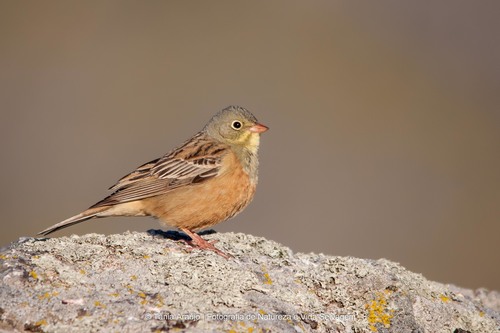


Ortolan Bunting
emberiza hortulana
The Ortolan Bunting is a small, elegantly colored songbird in the bunting family Emberizidae. Renowned for its melodious, sweet song and delicate features, this passerine breeds across Europe and Western Asia before embarking on a long-distance migration to sub-Saharan Africa for the winter. Historically, the Ortolan Bunting has been at the center of a controversial French culinary tradition where it was captured, fattened in darkness, and eaten whole under a shroud of secrecy. Today, the bird is strictly protected by law across the European Union, making sightings a rare and highly prized reward for birdwatchers tracking its decline in the wild.
Lebensraum: Inhabits open, warm, dry countryside with scattered trees, hedges, orchards, and traditional agricultural fields.
The Ortolan Bunting is roughly 16 cm long with a pinkish bill and a distinct yellow-ringed eye. The adult male features a grey-green head and chest, a conspicuous yellow throat and moustachial stripe, and warm, orange-buff underparts. Its back is warm brown with heavy dark-brown streaks, while females and young birds are duller, with finer streaks on their breasts and crown. Their wingspan ranges between 24 and 28 centimeters.
Kategorie
VögelSeltenheit
Common
Gefahr
1/5 · Sehr gering
Snaps
Mach den ersten Snap!
Capturing, selling, or harming Ortolan Buntings has been strictly banned under EU environmental directives since 1979, although underground poaching persisted for decades.
Former French President François Mitterrand famously requested the illicit Ortolan Bunting for his final, decadent New Year's Eve feast before his death.
To fatten captured Ortolans, they were traditionally kept in dark, windowless cages, which tricked their internal clock into thinking it was night, prompting continuous eating.
Traditional French diners would drape a large white napkin over their heads while eating the roasted bird to trap the delicate aromas and, symbolically, hide their greed from God.
Utilizes a highly sophisticated internal compass driven by the Earth's magnetic fields and stellar positioning to complete its long migratory journeys between Europe and sub-Saharan Africa.
Performs a sweet, metallic, and far-carrying song from elevated perches to successfully defend large territories in open agricultural landscapes.
Possesses a specialized, stout bill with an internal ridge that allows it to easily crack open and de-husk rigid grass and cereal seeds during the winter.
Relies heavily on small insects and invertebrates during the spring breeding season to feed its young, transitioning to a seed-based diet in autumn and winter.
Accipiter nisus
The Ortolan Bunting serves as prey for fast-flying avian predators in open and edge woodland habitats.
Melolontha melolontha
Adult bunting pairs hunt cockchafers and their larvae to feed their rapidly growing nestlings.
Für dieses Objekt sind noch keine Merkmal-Badges vergeben.
Noch keine Alternativnamen vorhanden.
Sammlungen für dieses Objekt erscheinen hier, wenn weitere Themen hinzugefügt werden.
Gefahr
1/5 · Sehr gering
Noch keine besonderen Sicherheitshinweise.
Der einfachste Weg, Ortolan Bunting zu bestimmen, ist die Verwendung der Naturführer-App Snappit.
1.5271618820464673e+64+ cm
2.4271618820464675e+64+ cm
0.02271618820464674+ kg
3.2716188204646737e+63+ Jahre
40 km/h
Relies heavily on small insects and invertebrates during the spring breeding season to feed its young, transitioning to a seed-based diet in autumn and winter.
Inhabits open, warm, dry countryside with scattered trees, hedges, orchards, and traditional agricultural fields.
Zoome hinein, um Cluster aufzulösen und zu sehen, wo dieses Objekt fotografiert wurde.
Neueste Snaps erscheinen hier, wenn neue Beobachtungen hinzukommen.










.jpg&width=800)







.JPG&width=800)