

Ouachita Blazing Star
liatris compacta
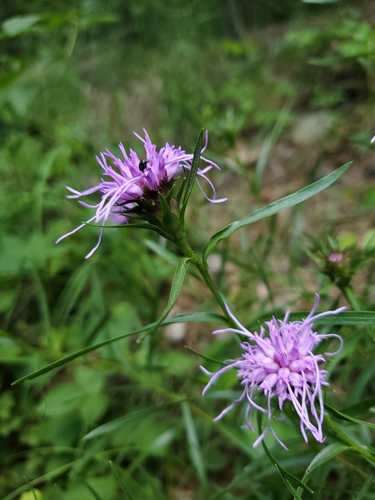
The Ouachita Blazing Star (Liatris compacta) is a rare and striking perennial wildflower endemic to the rugged Ouachita Mountains of Arkansas and Oklahoma. Standing out with its compact, densely packed spikes of purple-magenta flower heads, this resilient plant thrives where many others cannot—clinging to rocky sandstone and novaculite glades and open, thin-soiled woodlands. It plays a crucial ecological role in its restricted habitat, offering a vital nectar source for late-season pollinators. Unlike some of its wider-ranging relatives, the Ouachita Blazing Star has adapted specifically to the unique geologic formations of its mountainous home. Its late-summer blooms provide a sudden, brilliant splash of color against the dry, rocky outcrops, making it a highly sought-after sight for native plant enthusiasts and hikers exploring the Ouachita National Forest.
Lebensraum: Found in sandstone and novaculite glades, rocky outcrops, and open pine-oak woodlands with thin, acidic soils.
This compact herb typically grows between 20 to 50 centimeters tall, featuring upright, stiff stems that are densely crowded with narrow, grass-like leaves. In late summer, it produces a striking, unbranched spike of flower heads. Each flower head consists of vibrant purple to magenta disk florets, with no ray florets, giving them a fuzzy, feathered appearance. The bracts beneath the flower heads are distinctly appressed and sticky, which is a key distinguishing feature of this species compared to other blazing stars.
Kategorie
PflanzenSeltenheit
Common
Gefahr
1/5 · Sehr gering
Snaps
Mach den ersten Snap!
It is endemic to only a small handful of counties in Arkansas and Oklahoma, growing wild nowhere else in the world.
Its underground corm, a bulb-like stem, allows it to quickly sprout and regenerate after low-intensity wildfires.
The species name 'compacta' refers to its smaller, more condensed growth form compared to other blazing stars.
It thrives in nutrient-poor, rocky, and acidic soils where few other competing plant species can survive.
Features a deep, tuberous root system (corm) that stores water and nutrients, helping it survive hot, dry summer conditions.
Produces nectar with high sugar concentration during late summer, specifically timed to aid migrating butterflies and local bees.
As a photoautotrophic plant, it produces its own food through photosynthesis, utilizing sunlight, carbon dioxide, water, and soil minerals.
Danaus plexippus
Pollinates the flowers while gathering nectar.
Odocoileus virginianus
Feeds on the leaves and stems during spring growth.
Bombus pensylvanicus
Collects pollen and nectar, facilitating plant reproduction.
Für dieses Objekt sind noch keine Merkmal-Badges vergeben.
Noch keine Alternativnamen vorhanden.
Sammlungen für dieses Objekt erscheinen hier, wenn weitere Themen hinzugefügt werden.
Gefahr
1/5 · Sehr gering
Noch keine besonderen Sicherheitshinweise.
Der einfachste Weg, Ouachita Blazing Star zu bestimmen, ist die Verwendung der Naturführer-App Snappit.
20-50 cm
0.02-0.1 kg
3-10 Jahre
As a photoautotrophic plant, it produces its own food through photosynthesis, utilizing sunlight, carbon dioxide, water, and soil minerals.
Found in sandstone and novaculite glades, rocky outcrops, and open pine-oak woodlands with thin, acidic soils.
Zoome hinein, um Cluster aufzulösen und zu sehen, wo dieses Objekt fotografiert wurde.
Neueste Snaps erscheinen hier, wenn neue Beobachtungen hinzukommen.