

Owl Limpet
lottia gigantea
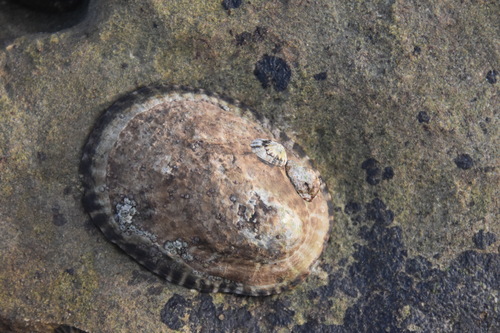
The Owl Limpet (Lottia gigantea) is an extraordinary marine gastropod native to the rocky intertidal zones of the Pacific coast of North America. Renowned for its highly territorial behavior, this is no passive snail. Instead, the Owl Limpet acts as an industrious gardener, actively cultivating and defending a patch of microalgae on the rock face. It aggressively bulldozes intruders, including other limpets, barnacles, and anemones, to protect its primary food source. What makes this mollusk even more fascinating is its life history; they are protandrous hermaphrodites, beginning their lives as males and transitioning into females as they grow larger and establish their territories. Their shells, which feature an interior muscle scar resembling the silhouette of an owl, have been prized by coastal humans for centuries.
Lebensraum: Found on wave-swept rocky shores in the high- to mid-intertidal zones, securely clinging to vertical rock faces.
The Owl Limpet is characterized by its large, low, oval cap-shaped shell, which typically ranges from 5 to 10 cm in length. The exterior of the shell is dark brown, often heavily eroded or encrusted with microalgae and barnacles, which helps it blend seamlessly into the surrounding rocky shoreline. Inside, the shell has a smooth, bluish-white interior featuring a dark brown border and a distinctive horseshoe-shaped muscle scar that bears a striking resemblance to the profile of an owl.
Kategorie
InvertebrateSeltenheit
Common
Gefahr
1/5 · Sehr gering
Snaps
Mach den ersten Snap!
Because they change sex from male to female as they grow, the largest individuals in any colony are almost exclusively female.
The interior of the owl limpet shell features a dark, glossy muscle scar that remarkably resembles the outline of a perched owl.
They act like miniature bulldozers, pushing other limpets, barnacles, and even small anemones completely out of their territories.
Actively cultivates patches of microalgae and aggressively bulldozes competitors or encroaching organisms from its feeding territory.
Returns to the exact same spot on the rock after foraging, where its shell fits perfectly to prevent drying out during low tide.
Begins life as a male and transitions into a female upon reaching a larger size, optimizing reproductive success within its territory.
Feeds primarily on the thin film of microalgae and blue-green algae that it actively cultivates and grooms within its established territory.
Altersunterschiede: Juveniles feed opportunistically on available microalgae films before establishing and defending their own algal gardens as they mature.
Haematopus bachmani
Preys on owl limpets by prying them off rocks with its specialized chisel-like bill.
Tegula funebralis
Pushed out or bulldozed from the owl limpet's territory to prevent overgrazing of the algal garden.
Pisaster ochraceus
Preys on various intertidal mollusks, though large owl limpets can sometimes resist or escape them.
Für dieses Objekt sind noch keine Merkmal-Badges vergeben.
Noch keine Alternativnamen vorhanden.
Sammlungen für dieses Objekt erscheinen hier, wenn weitere Themen hinzugefügt werden.
Gefahr
1/5 · Sehr gering
Noch keine besonderen Sicherheitshinweise.
Der einfachste Weg, Owl Limpet zu bestimmen, ist die Verwendung der Naturführer-App Snappit.
5-10 cm
0.03-0.15 kg
10-15 Jahre
Feeds primarily on the thin film of microalgae and blue-green algae that it actively cultivates and grooms within its established territory.
Found on wave-swept rocky shores in the high- to mid-intertidal zones, securely clinging to vertical rock faces.
Grazing
Zoome hinein, um Cluster aufzulösen und zu sehen, wo dieses Objekt fotografiert wurde.
Neueste Snaps erscheinen hier, wenn neue Beobachtungen hinzukommen.











