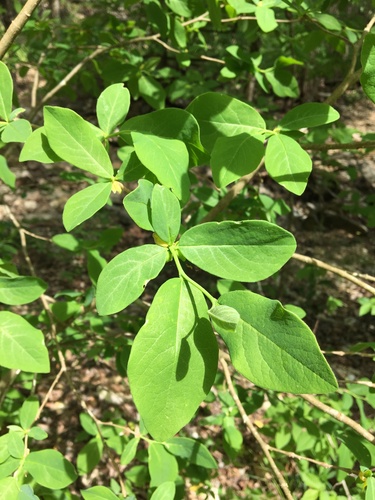


Ozark Leatherwood
dirca decipiens
The Ozark Leatherwood (Dirca decipiens) is a unique and captivating deciduous shrub native to the Ozark Plateau. This plant is celebrated for its exceptionally flexible and durable wood, which historically earned it the common name 'leatherwood' due to its resistance to breaking. It stands out in early spring by producing delicate yellow flowers before its leaves emerge, providing a crucial early nectar source for pollinators when few other plants are in bloom. Its restricted geographic range and specific habitat requirements make it a species of significant ecological interest and conservation concern within its native ecosystem.
Lebensraum: Found in moist, shaded woodlands, often on rocky slopes, bluffs, and along stream banks in rich deciduous forests.
This deciduous shrub typically grows to a height of 1 to 3 meters, forming a multi-stemmed, rounded shape. Its most distinctive features include smooth, brownish-gray bark and remarkably pliable, whip-like branches. In early spring, small, bell-shaped, pale yellow flowers appear in clusters at the tips of the branches, often before the leaves. The leaves are alternate, obovate to elliptic in shape, bright green, turning a vibrant yellow in autumn. Small, green drupe fruits mature in early summer, often overlooked against the foliage.
Kategorie
PflanzenSeltenheit
Common
Gefahr
1/5 · Sehr gering
Snaps
Mach den ersten Snap!
Its unique ability to flower in early spring before developing leaves makes it a critical food source for early-emerging insect pollinators when other floral resources are scarce.
Ozark Leatherwood is one of only four recognized species in the genus Dirca, all of which are native to North America, making it a distinctive part of the continent's flora.
The incredibly pliable wood of Ozark Leatherwood was historically used by Native Americans for making bindings, baskets, and thongs, thanks to its exceptional strength and flexibility.
The species name 'decipiens' means 'deceiving' or 'misleading' in Latin, possibly referring to its similarity to another Dirca species or a botanical feature that once caused confusion among botanists.
The wood of Dirca decipiens is exceptionally flexible and strong, giving rise to its common name 'leatherwood' due to its remarkable resistance to breaking under stress.
Produces its small, yellow, bell-shaped flowers in early spring before the leaves unfurl, making it one of the first shrubs to flower and a vital early nectar source.
Thrives in the understory of deciduous forests, adapting well to partial shade conditions and moist, nutrient-rich soils characteristic of its native woodland habitat.
As a photosynthetic organism, Ozark Leatherwood produces its own food using sunlight, water, and carbon dioxide, converting these into sugars for energy and growth, supplemented by soil-borne nutrients.
Andrena spp.
Provides early nectar and pollen for pollinators.
Turdus migratorius
Birds consume the ripe fruits and help spread seeds.
Various species
Forms symbiotic relationships with fungi to enhance nutrient uptake from the soil.
Odocoileus virginianus
Deer may browse foliage, especially young shoots, but it's not a primary food source.
Für dieses Objekt sind noch keine Merkmal-Badges vergeben.
Noch keine Alternativnamen vorhanden.
Sammlungen für dieses Objekt erscheinen hier, wenn weitere Themen hinzugefügt werden.
Gefahr
1/5 · Sehr gering
Noch keine besonderen Sicherheitshinweise.
Der einfachste Weg, Ozark Leatherwood zu bestimmen, ist die Verwendung der Naturführer-App Snappit.
100-300 cm
5-25 kg
20-70 Jahre
As a photosynthetic organism, Ozark Leatherwood produces its own food using sunlight, water, and carbon dioxide, converting these into sugars for energy and growth, supplemented by soil-borne nutrients.
Found in moist, shaded woodlands, often on rocky slopes, bluffs, and along stream banks in rich deciduous forests.
Photosynthesis
Zoome hinein, um Cluster aufzulösen und zu sehen, wo dieses Objekt fotografiert wurde.
Neueste Snaps erscheinen hier, wenn neue Beobachtungen hinzukommen.













