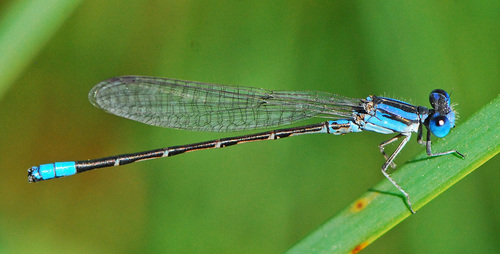


Paiute Dancer
argia alberta
The Paiute Dancer (Argia alberta) is a captivating damselfly native to the spring-fed wetlands, seeps, and slow-flowing streams of western North America. Belonging to the dancer genus, so named for their bouncy and erratic flight patterns, this small insect plays a vital role as both a predator and prey within its sensitive aquatic ecosystems. Often found resting on sunny rocks near water sources, the Paiute Dancer is highly appreciated by nature observers for its vibrant coloration and intriguing territorial behaviors. Unlike many other damselflies that prefer perching on vertical reeds, these hardy insects are ground-dwellers at heart, frequently utilizing warm stones to regulate their body temperature in cooler climates.
Lebensraum: Typically found near slow-flowing streams, thermal springs, seeps, and wet meadows in arid or semi-arid regions of western North America.
Adult males display a striking, brilliant powder-blue abdomen marked with delicate black rings, while their thorax features bold blue and black striping. Females are more cryptically colored, typically appearing in shades of tan, brown, or dull grey to remain camouflaged while laying eggs. They possess clear, membranous wings with dark stigmas at the outer tips, and their total body length ranges from 2.8 to 3.4 centimeters, featuring the delicate, slender build characteristic of pond damselflies.
Kategorie
InsektenSeltenheit
Common
Gefahr
1/5 · Sehr gering
Snaps
Mach den ersten Snap!
During egg-laying, the male often remains physically attached to the female in a tandem link to guard her from other competing males.
The common name 'Paiute' honors the indigenous Paiute people who traditionally inhabited the Great Basin region where this damselfly is commonly found.
Unlike typical damselflies that perch on vertical twigs, dancers are famous for landing flat on horizontal surfaces like rocks or the ground.
They fly with a distinctive dancing motion that makes them difficult for aerial predators like birds and larger dragonflies to track and capture.
They frequently land on flat, sun-baked rocks or bare ground to quickly absorb heat, allowing them to remain active in cooler morning temperatures.
During mating, they form a unique tandem wheel structure that allows them to fly and seek safe egg-laying sites together.
As opportunistic aerial predators, adults hunt small flying insects, while their aquatic larvae feed on tiny underwater organisms.
Altersunterschiede: Larval nymphs are aquatic generalists that feed on mosquito larvae and daphnia, while winged adults hunt flying insects in the air.
Sayornis phoebe
Adults are frequently preyed upon by small insectivorous birds nesting near riparian corridors.
Culex pipiens
Both larvae and adults consume large quantities of mosquito larvae and adults, acting as natural pest controllers.
Rana luteiventris
Nymphs in shallow spring pools are preyed upon by native aquatic amphibians.
Für dieses Objekt sind noch keine Merkmal-Badges vergeben.
Noch keine Alternativnamen vorhanden.
Sammlungen für dieses Objekt erscheinen hier, wenn weitere Themen hinzugefügt werden.
Gefahr
1/5 · Sehr gering
Noch keine besonderen Sicherheitshinweise.
Der einfachste Weg, Paiute Dancer zu bestimmen, ist die Verwendung der Naturführer-App Snappit.
2-4 cm
3-5 cm
0.00005-0.00015 kg
0-1 Jahre
15 km/h
As opportunistic aerial predators, adults hunt small flying insects, while their aquatic larvae feed on tiny underwater organisms.
Typically found near slow-flowing streams, thermal springs, seeps, and wet meadows in arid or semi-arid regions of western North America.
Zoome hinein, um Cluster aufzulösen und zu sehen, wo dieses Objekt fotografiert wurde.
Neueste Snaps erscheinen hier, wenn neue Beobachtungen hinzukommen.

















.jpg&width=800)

