

Pancake Pricklypear
opuntia chlorotica
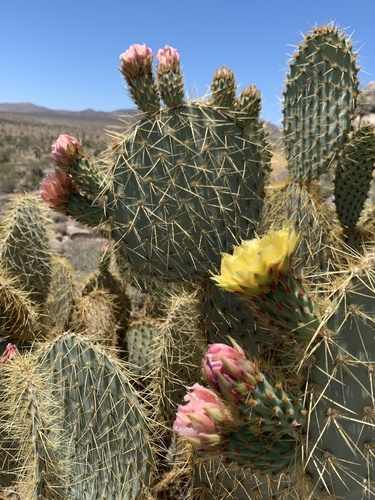
The Pancake Pricklypear (Opuntia chlorotica) is a striking, tree-like cactus native to the arid mountains and rocky canyons of the Southwestern United States and northern Mexico. Known for its upright growth and unique circular pads, this hardy plant acts as a vital sanctuary and hydration source for desert wildlife. Its brilliant yellow flowers bloom in late spring, transforming the dry landscape with bursts of color and attracting a diverse array of pollinators. As a resilient desert survivor, it has evolved complex adaptations to thrive under intense heat and minimal rainfall, making it an iconic and fascinating component of desert ecosystems.
Lebensraum: Typically found on dry, rocky slopes, canyon walls, and desert mountain foothills at elevations between 600 and 1,800 meters.
This cactus grows as an upright, bushy shrub or small tree, reaching heights of 100 to 250 centimeters. It is easily identified by its extremely round, flat, pancake-like pads which are pale yellow-green in color. The pads are densely covered in clusters of sharp, bright yellow spines that typically point downwards. In spring, it produces beautiful, cup-shaped yellow flowers that are often tinged with red at the base, followed by fleshy, spherical fruits that ripen to a reddish-purple hue.
Kategorie
PflanzenSeltenheit
Common
Gefahr
1/5 · Sehr gering
Snaps
Mach den ersten Snap!
During freezing winters, the pads can produce high concentrations of sugars that act as a natural antifreeze.
Its common name comes from the remarkably flat, round shape of its pads, which resemble a stack of green pancakes.
The brilliant yellow spines point downward, a clever adaptation that helps channel scarce rainwater directly toward the root zone.
Absorbs carbon dioxide exclusively at night to drastically reduce water loss through transpiration during the scorching desert days.
Deploys microscopic, easily detached barbed hairs called glochids that cause severe irritation to herbivore mouthparts.
Can safely lose a massive percentage of its water volume during droughts, shriveling its pads without damaging its internal tissues.
As an autotrophic plant, it manufactures its own organic compounds and energy through photosynthesis utilizing sunlight, carbon dioxide, and soil moisture.
Campylorhynchus brunneicapillus
Nests within the sharp spines of the cactus pads to protect its eggs and chicks from ground predators.
Ovis canadensis nelsoni
Feeds on the moisture-rich pads and nutritious fruits, carefully navigating around the dense spines.
Bombus sonorus
Feeds on the sugary nectar of the yellow flowers, assisting the cactus in cross-pollination.
Für dieses Objekt sind noch keine Merkmal-Badges vergeben.
Noch keine Alternativnamen vorhanden.
Sammlungen für dieses Objekt erscheinen hier, wenn weitere Themen hinzugefügt werden.
Gefahr
1/5 · Sehr gering
Noch keine besonderen Sicherheitshinweise.
Der einfachste Weg, Pancake Pricklypear zu bestimmen, ist die Verwendung der Naturführer-App Snappit.
100-250 cm
5-60 kg
20-50 Jahre
As an autotrophic plant, it manufactures its own organic compounds and energy through photosynthesis utilizing sunlight, carbon dioxide, and soil moisture.
Typically found on dry, rocky slopes, canyon walls, and desert mountain foothills at elevations between 600 and 1,800 meters.
Zoome hinein, um Cluster aufzulösen und zu sehen, wo dieses Objekt fotografiert wurde.
Neueste Snaps erscheinen hier, wenn neue Beobachtungen hinzukommen.

California, US
Hier kann man sehen Western Joshua Tree und Engelmann's Hedgehog Cactus.
Führer anzeigen →

California, US
Hier kann man sehen Western Joshua Tree, Feuerkaktus und Beavertail Pricklypear.
Führer anzeigen →








.jpg&width=800)



_(14586807078).jpg&width=800)

