

Parry'S Milkvetch
astragalus parryi
Parry's Milkvetch (Astragalus parryi) is a charming perennial herb native to the subalpine and montane regions of western North America. A member of the vast pea family (Fabaceae), this plant is a vital component of its ecosystem, contributing to soil health through its ability to fix atmospheric nitrogen. It is well-adapted to harsh, dry, and rocky environments, thriving where many other plants struggle. Its distinctive flowers and inflated seed pods make it a recognizable sight in its high-altitude habitats.
Lebensraum: Found on dry, rocky slopes, open woodlands, and subalpine meadows, often in gravelly or sandy soils, typically at elevations between 1,800 and 3,600 meters.
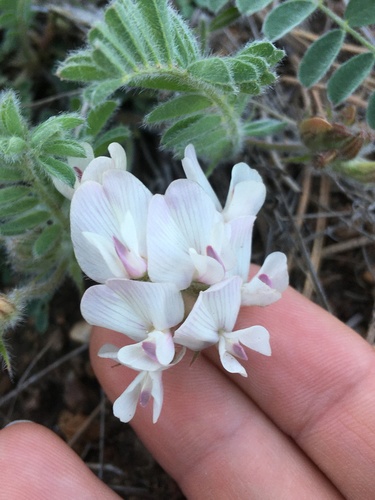
This upright perennial typically grows between 10 to 50 centimeters tall, featuring stems that may be simple or branched. Its leaves are pinnately compound, meaning they consist of multiple leaflets arranged along a central stem, often giving the plant a somewhat feathery appearance. The most striking features are its pea-like flowers, which bloom in racemes (clusters along a stem) and display a vibrant range of colors from purple to pinkish-purple. Following the flowers, distinctive inflated, often hairy, seed pods develop, which are ovoid to oblong in shape and give the plant its characteristic 'vetch' appearance.
Kategorie
PflanzenSeltenheit
Common
Gefahr
1/5 · Sehr gering
Snaps
Mach den ersten Snap!
Astragalus is one of the largest genera of flowering plants, with over 3,000 recognized species worldwide, making Parry's Milkvetch part of an incredibly diverse family.
Parry's Milkvetch plays a crucial role in preventing soil erosion on steep, rocky slopes due to its extensive root system.
The common name 'milkvetch' historically stems from an old belief that grazing livestock on these plants would increase their milk production.
The genus name 'Astragalus' comes from a Greek word referring to ankle bones, possibly alluding to the shape of the seeds or seed pods of some species.
Like other legumes, Parry's Milkvetch forms a symbiotic relationship with Rhizobium bacteria in its root nodules, converting atmospheric nitrogen into a usable form for itself and enriching the surrounding soil.
It possesses adaptations that allow it to thrive in arid conditions, including deep root systems and efficient water use, making it resilient in dry, rocky montane environments.
This species is often found in soils with higher alkalinity, demonstrating a natural tolerance and preference for such mineral-rich substrates common in mountainous regions.
As a photosynthetic organism, Parry's Milkvetch produces its own energy by converting sunlight into sugars. It absorbs water and essential mineral nutrients from the soil through its root system.
Bombus spp.
Pollination for reproduction
Odocoileus hemionus
Source of food for herbivores
Rhizobium spp.
Symbiotic nitrogen fixation in root nodules
Cervus canadensis
Grazing on plant foliage
Für dieses Objekt sind noch keine Merkmal-Badges vergeben.
Noch keine Alternativnamen vorhanden.
Sammlungen für dieses Objekt erscheinen hier, wenn weitere Themen hinzugefügt werden.
Gefahr
1/5 · Sehr gering
Noch keine besonderen Sicherheitshinweise.
Der einfachste Weg, Parry'S Milkvetch zu bestimmen, ist die Verwendung der Naturführer-App Snappit.
10-50 cm
3-15 Jahre
As a photosynthetic organism, Parry's Milkvetch produces its own energy by converting sunlight into sugars. It absorbs water and essential mineral nutrients from the soil through its root system.
Found on dry, rocky slopes, open woodlands, and subalpine meadows, often in gravelly or sandy soils, typically at elevations between 1,800 and 3,600 meters.
Foraging
500-5000
Zoome hinein, um Cluster aufzulösen und zu sehen, wo dieses Objekt fotografiert wurde.
Neueste Snaps erscheinen hier, wenn neue Beobachtungen hinzukommen.