

Pea Blue
lampides boeticus
The Pea Blue, also known as the Long-tailed Blue, is a remarkably widespread and resilient butterfly belonging to the gossamer-winged butterfly family (Lycaenidae). Renowned for its extraordinary migratory capabilities, this delicate insect can cross vast expanses of ocean and land, making it one of the most widely distributed butterflies on Earth. It is a familiar sight in gardens and agricultural areas across Europe, Africa, Asia, and Australia. As its name suggests, the Pea Blue is inextricably linked to leguminous plants, often laying its eggs on peas, beans, and broom. Its striking coloration and fascinating survival strategies, such as the use of decoy false heads to evade predators and mutualistic partnerships with ants, make it a captivating subject for nature enthusiasts and lepidopterists alike.
Lebensraum: Found in open woodlands, agricultural fields, meadows, and urban gardens, typically wherever leguminous host plants are abundant.
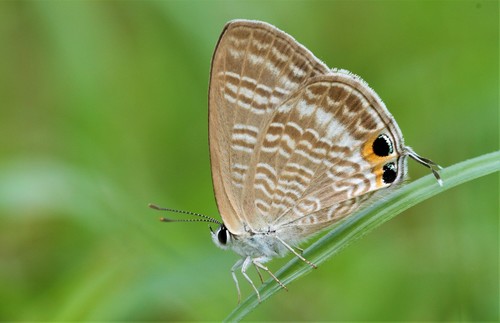
The Pea Blue is a small butterfly with a wingspan of 24 to 34 millimeters. Males boast a vibrant, iridescent violet-blue on their upper wings, while females are predominantly brown with blue dusting restricted to the wing bases. The defining feature for both sexes is the underside of their wings, which is a pale fawn color patterned with intricate, wavy white streaks. At the lower rear edge of each hindwing, they sport two prominent black eye-spots rimmed with bright orange, alongside a delicate, hair-like tail. This combination creates the illusion of a false head.
Kategorie
InsektenSeltenheit
Common
Gefahr
1/5 · Sehr gering
Snaps
Mach den ersten Snap!
Because their caterpillars frequently burrow into pea and bean pods to feed, they are sometimes considered a minor agricultural pest.
The Pea Blue is known as the Long-tailed Blue in the UK, where it is a rare but increasingly frequent migrant from southern Europe.
This species is remarkably cosmopolitan and was one of the few butterfly species naturally found in Hawaii before extensive human settlement.
When resting, the butterfly rubs its hindwings together, which makes its false head tails wiggle like real antennae to deceive predators.
The butterfly sports hair-like tails and eye-spots on the rear of its hindwings that mimic antennae and eyes, tricking predators into striking a non-lethal part of the wing.
Despite their fragile appearance, Pea Blues are powerful flyers capable of undertaking massive cross-continental migrations over hundreds of kilometers.
The caterpillars secrete sweet, nutrient-rich honeydew from a specialized gland to attract ants, which in turn protect the vulnerable larvae from predators.
Caterpillars feed almost exclusively on the flowers and seed pods of leguminous plants, while adults forage for floral nectar.
Altersunterschiede: Larvae consume solid plant material, specifically targeting nitrogen-rich reproductive parts of legumes, whereas adults exclusively consume liquid nectar.
Pisum sativum
Host plant for laying eggs and caterpillar feeding.
Lasius niger
Caterpillars are attended by ants that protect them in exchange for honeydew.
Araneus diadematus
Often caught in the webs of orb-weaving spiders while foraging in gardens.
Für dieses Objekt sind noch keine Merkmal-Badges vergeben.
Noch keine Alternativnamen vorhanden.
Sammlungen für dieses Objekt erscheinen hier, wenn weitere Themen hinzugefügt werden.
Gefahr
1/5 · Sehr gering
Noch keine besonderen Sicherheitshinweise.
Der einfachste Weg, Pea Blue zu bestimmen, ist die Verwendung der Naturführer-App Snappit.
1-2 cm
2-4 cm
0.0001-0.0003 kg
bis zu 1 Jahre
15 km/h
Caterpillars feed almost exclusively on the flowers and seed pods of leguminous plants, while adults forage for floral nectar.
Found in open woodlands, agricultural fields, meadows, and urban gardens, typically wherever leguminous host plants are abundant.
Zoome hinein, um Cluster aufzulösen und zu sehen, wo dieses Objekt fotografiert wurde.
Neueste Snaps erscheinen hier, wenn neue Beobachtungen hinzukommen.
















.jpg&width=800)