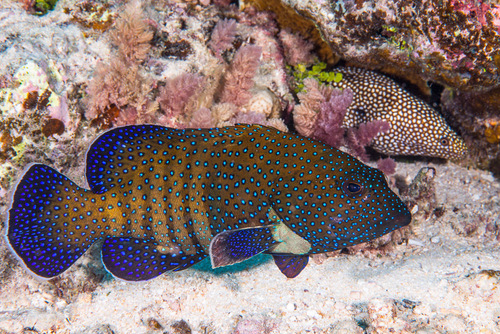


Peacock Grouper
cephalopholis argus
The Peacock Grouper, also known as the celestial grouper or argus grouper, is a stunning and ecologically significant predator inhabiting Indo-Pacific coral reefs. Adorned with a striking pattern of iridescent blue spots over a dark body, this medium-sized fish is a master of the reef understory. It plays a vital role as an apex predator in its native habitats, keeping populations of smaller reef fish in balance and maintaining reef health. However, its introduction to Hawaii in the 1950s led to it becoming an invasive species, where it is known locally as 'roi' and is heavily managed due to its impact on native species. Despite this, in its native range, it remains a beloved sighting for snorkelers and divers, often seen hovering near caves and coral formations. It exhibits fascinating social structures, with dominant males defending territories that encompass the home ranges of several females. Their interactions with other reef dwellers, including cooperative hunting efforts, make them one of the most intellectually compelling fish to observe in the wild.
Lebensraum: Found in shallow coral reefs, clear lagoons, and rocky marine areas up to depths of forty meters.
The Peacock Grouper is characterized by a robust, compressed body covered in hundreds of brilliant, neon-blue spots, each finely ringed in black, set against a dark brown, olive, or near-black background. Its rear body often displays five to six pale, vertical bars, and the margins of its pectoral and tail fins are typically edged in bright blue or white. It features a large, upturned mouth equipped with multiple rows of small, sharp teeth, and can reach a maximum length of about sixty centimeters.
Kategorie
FischeSeltenheit
Common
Gefahr
1/5 · Sehr gering
Snaps
Mach den ersten Snap!
Dominant males are highly territorial, defending a large home range that overlappingly contains the territories of up to twelve females.
Known as 'Roi' in Hawaii, this fish was intentionally introduced in 1956 to enhance local fisheries but has since become an invasive pest.
They are ciguatoxic in certain regions, meaning they bioaccumulate ciguatoxins from their prey, making them dangerous for humans to eat.
Signals and coordinates with moray eels and octopuses using head-shakes to flush out prey from tight crevices.
Capable of rapidly shifting its body coloration to show distinct pale vertical bars to blend with reef shadows or signal territory.
Uses its large mouth to create a powerful negative pressure vacuum, instantly drawing in unsuspecting prey from several inches away.
A nocturnal and crepuscular predator that feeds heavily on small reef fish and occasionally targets crabs and shrimps.
Altersunterschiede: Juveniles primarily feed on small benthic crustaceans like copepods and shrimps, transitioning to a fish-dominated diet as they mature.
Gymnothorax javanicus
Often hunts cooperatively with this species, utilizing head signals to target hidden prey.
Ctenochaetus strigosus
A common prey item of the peacock grouper in coral reef environments.
Carcharhinus melanopterus
A larger apex predator that preys upon the peacock grouper in shallow reef ecosystems.
Für dieses Objekt sind noch keine Merkmal-Badges vergeben.
Noch keine Alternativnamen vorhanden.
Sammlungen für dieses Objekt erscheinen hier, wenn weitere Themen hinzugefügt werden.
Gefahr
1/5 · Sehr gering
Noch keine besonderen Sicherheitshinweise.
Der einfachste Weg, Peacock Grouper zu bestimmen, ist die Verwendung der Naturführer-App Snappit.
30-60 cm
1-5.5 kg
10-20 Jahre
A nocturnal and crepuscular predator that feeds heavily on small reef fish and occasionally targets crabs and shrimps.
Found in shallow coral reefs, clear lagoons, and rocky marine areas up to depths of forty meters.
Ambush
10000-80000
Zoome hinein, um Cluster aufzulösen und zu sehen, wo dieses Objekt fotografiert wurde.
Neueste Snaps erscheinen hier, wenn neue Beobachtungen hinzukommen.












