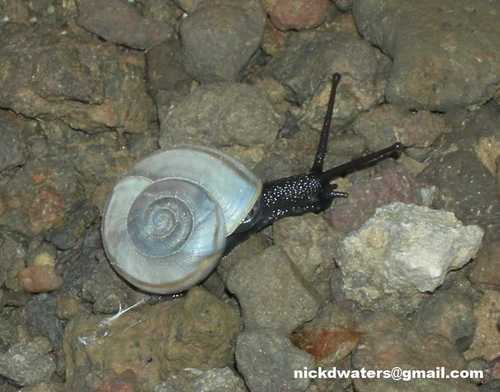


Phoenix Talussnail
sonorella allynsmithi
The Phoenix Talussnail (Sonorella allynsmithi) is a fascinating, highly specialized land snail endemic to the arid landscapes of central Arizona. As a member of the 'talussnails,' this species has adapted to survive the extreme temperatures and dry conditions of the Sonoran Desert by seeking refuge deep within rocky talus slopes. During prolonged dry spells, the snail aestivates, retreating deep into the rock piles and sealing itself inside its shell to conserve moisture for months or even years. It is a remarkable example of micro-endemism, showcasing how life can adapt, specialize, and persist in seemingly inhospitable desert rock habitats. Because their habitat is so fragmented, each mountain's population remains completely isolated, making them uniquely treasured symbols of desert biodiversity.
Lebensraum: Found exclusively within the cool, moist crevices of large rock slides (talus slopes) on the sides of desert mountains.
The Phoenix Talussnail features a flattened, spiraled shell that typically measures about 1 to 3 centimeters in diameter. Its shell is a pale, muted tan or light brown, which provides excellent camouflage against sun-baked desert rocks, and it is usually marked by a distinct, thin dark chestnut-brown band running along the periphery of the whorls. The snail's soft body is generally a pale gray or brownish-gray, featuring a slightly translucent quality. It possesses two pairs of tentacles on its head, with the upper, longer pair bearing its eye spots.
Kategorie
InvertebrateSeltenheit
Common
Gefahr
1/5 · Sehr gering
Snaps
Mach den ersten Snap!
Because they rely strictly on deep rock piles and cannot cross the hot desert floor, populations on different mountains are entirely isolated, acting like 'sky islands' for snails.
The Phoenix Talussnail spends over 90% of its life asleep, only waking up during heavy desert rainstorms to eat and mate.
They possess thousands of microscopic teeth on a ribbon-like structure called a radula, which they use like sandpaper to scrape stubborn food off rough desert rocks.
To survive the scorching Sonoran Desert heat, they secrete a specialized mucous seal over their shell opening that hardens like parchment to lock in moisture.
Survives harsh, dry desert periods by sealing its shell aperture with a dried mucus plug called an epiphragm, conserving vital moisture for months.
Relies on the deep, stable microclimates of rock slides where temperatures remain cool and humidity is much higher than the desert surface.
Uses a specialized ribbon of thousands of microscopic teeth, known as a radula, to effectively scrape tough lichens and algae off rough stone surfaces.
Feeds primarily on decaying plant material, fungi, and lichens scraped from rocks in its environment.
Altersunterschiede: Hatchlings typically consume softer organic detritus and calcium-rich soil to build their shells before graduating to tougher lichens.
Neotoma albigula
Preyed upon by small desert rodents capable of cracking their shells.
Incilius alvarius
Eaten by opportunistic desert amphibians during the rainy season.
Xanthoparmelia cumberlandia
Consumes various desert rock lichens for sustenance.
Für dieses Objekt sind noch keine Merkmal-Badges vergeben.
Noch keine Alternativnamen vorhanden.
Sammlungen für dieses Objekt erscheinen hier, wenn weitere Themen hinzugefügt werden.
Gefahr
1/5 · Sehr gering
Noch keine besonderen Sicherheitshinweise.
Der einfachste Weg, Phoenix Talussnail zu bestimmen, ist die Verwendung der Naturführer-App Snappit.
1-3 cm
0.001-0.005 kg
2-5 Jahre
Feeds primarily on decaying plant material, fungi, and lichens scraped from rocks in its environment.
Found exclusively within the cool, moist crevices of large rock slides (talus slopes) on the sides of desert mountains.
Foraging
10-40
Zoome hinein, um Cluster aufzulösen und zu sehen, wo dieses Objekt fotografiert wurde.
Neueste Snaps erscheinen hier, wenn neue Beobachtungen hinzukommen.

















