

Pimelia Costata
pimelia costata
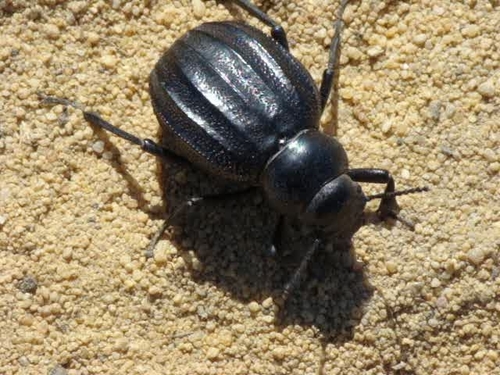
Pimelia costata, also known as the Gran Canaria giant darkling beetle, is a remarkable flightless insect endemic to the coastal dunes and dry scrublands of Gran Canaria. Adapted to live in some of the island's most arid environments, this rugged beetle plays a crucial ecological role as a detritivore, recycling scarce organic material back into the sandy soil. Due to heavy tourism and urban development destroying its natural habitats, this unique beetle faces severe conservation challenges and is highly protected.
Lebensraum: Typically found in coastal sand dunes, sandy beaches, and xerophytic cardonal-tabaibal scrublands of Gran Canaria.
Measuring between 1.8 and 2.5 centimeters in length, this beetle features a sturdy, rounded, matte-black exoskeleton. Its most defining characteristic is the series of prominent, raised longitudinal ridges, or costae, running along its fused elytra. Because it is completely flightless, it lacks functional hind wings, giving it a heavy, robust appearance with strong, thick legs well-suited for crawling and digging through shifting sands.
Kategorie
InsektenSeltenheit
Common
Gefahr
1/5 · Sehr gering
Snaps
Mach den ersten Snap!
Since they are entirely flightless, their wing covers have evolved to act as a physical shield to protect them from dehydration.
They are micro-endemic, meaning they are native to a single island in the world and cannot be found anywhere else naturally.
When threatened, they often play dead by rolling onto their backs and freezing their legs, a defense mechanism called thanatosis.
Uses its ridged, matte exoskeleton to capture morning dew and moisture from coastal fog, allowing water droplets to slide directly to its mouthparts.
Its wing cases are tightly fused together to form a sealed internal chamber, drastically reducing moisture loss in scorching temperatures.
Possesses strong, spade-like forelegs that allow it to quickly dig under loose sand to escape predators and extreme midday heat.
Feeds opportunistically on decaying plant matter, fallen seeds, and dead insects found on the ground.
Altersunterschiede: Larvae live underground feeding on decomposing roots, while adults forage on the surface.
Gallotia stehlini
Preyed upon by this large endemic lizard species of Gran Canaria.
Euphorbia canariensis
Consumes decaying leaf litter and fallen debris from this endemic spurge.
Für dieses Objekt sind noch keine Merkmal-Badges vergeben.
Noch keine Alternativnamen vorhanden.
Sammlungen für dieses Objekt erscheinen hier, wenn weitere Themen hinzugefügt werden.
Gefahr
1/5 · Sehr gering
Noch keine besonderen Sicherheitshinweise.
Der einfachste Weg, Pimelia Costata zu bestimmen, ist die Verwendung der Naturführer-App Snappit.
1-2 cm
0.001-0.003 kg
1-3 Jahre
1 km/h
Feeds opportunistically on decaying plant matter, fallen seeds, and dead insects found on the ground.
Typically found in coastal sand dunes, sandy beaches, and xerophytic cardonal-tabaibal scrublands of Gran Canaria.
Foraging
Zoome hinein, um Cluster aufzulösen und zu sehen, wo dieses Objekt fotografiert wurde.
Neueste Snaps erscheinen hier, wenn neue Beobachtungen hinzukommen.