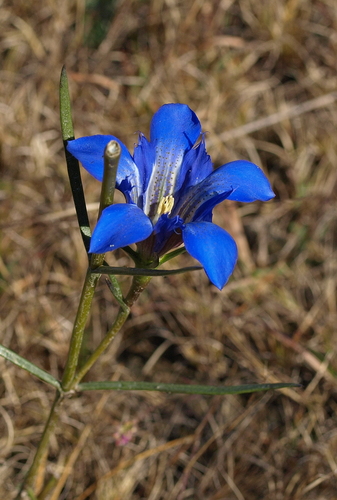


Pine Barren Gentian
gentiana autumnalis
The Pine Barren Gentian is an exquisite perennial wildflower native to the damp, acidic sands of the Atlantic coastal plain of the eastern United States. Renowned for its breathtakingly vivid blue blossoms, this late-season beauty acts as a brilliant jewel in the fading autumn landscape of the Pine Barrens. Historically prized by botanists and nature lovers alike, it stands as a symbol of the unique, fire-dependent pine flatwood ecosystems that are increasingly threatened by development and fire suppression. This species grows low to the ground with slender, upright stems. Unlike many other summer-blooming wildflowers, the Pine Barren Gentian waits until late September to November to unfurl its solitary, funnel-shaped flowers, providing a vital late-season nectar source for specialized pollinators.
Lebensraum: Typically found in damp, acidic, sandy soils of pine savannas, wet flatwoods, and open, sunny bogs.
This plant is easily identified by its single, terminal, bell-shaped flowers of an intense, electric-blue to deep violet-blue color, measuring 3 to 5 centimeters across. The throat of the flower frequently features delicate green-yellow streaks or white mottling inside. Its slender, wire-like stems are often reddish-purple and can grow up to 50 centimeters tall, adorned with narrow, linear, dark green leaves arranged in opposite pairs along the stem.
Kategorie
PflanzenSeltenheit
Common
Gefahr
1/5 · Sehr gering
Snaps
Mach den ersten Snap!
It is considered a 'fire-follower,' blooming in much higher densities in the years immediately following a pine barrens wildfire.
The intense electric-blue pigment of this gentian is exceptionally rare among autumn-blooming wild plants.
Wild seed harvesting and habitat loss have made this one of the most highly protected wildflower species in the state of New Jersey.
The flowers exhibit photonastic movement, opening wide on bright, sunny days to attract pollinators and closing during cloudy weather or at night to protect delicate reproductive organs.
Adapted to thrive in highly acidic, nutrient-deficient sandy soils where most other plant species struggle to survive.
Utilizes a deep, sturdy perennial root system to survive forest fires, rapidly resprouting to take advantage of newly cleared understories.
As a photoautotrophic plant, it produces its own energy through photosynthesis, utilizing sunlight, carbon dioxide, and water while absorbing basic minerals from acidic soil.
Bombus pensylvanicus
Pollinated mainly by large bumblebees that have the strength to pry open the tube-like petals to reach the nectar.
Glomus intraradices
Relies on underground mycorrhizal fungi network to assist with nutrient absorption in nutrient-poor sandy soils.
Vaccinium corymbosum
Competes for sunlight and space in the understory of pine flatwoods when fire suppression allows shrubs to overgrown.
Für dieses Objekt sind noch keine Merkmal-Badges vergeben.
Noch keine Alternativnamen vorhanden.
Sammlungen für dieses Objekt erscheinen hier, wenn weitere Themen hinzugefügt werden.
Gefahr
1/5 · Sehr gering
Noch keine besonderen Sicherheitshinweise.
Der einfachste Weg, Pine Barren Gentian zu bestimmen, ist die Verwendung der Naturführer-App Snappit.
20-50 cm
3-10 Jahre
As a photoautotrophic plant, it produces its own energy through photosynthesis, utilizing sunlight, carbon dioxide, and water while absorbing basic minerals from acidic soil.
Typically found in damp, acidic, sandy soils of pine savannas, wet flatwoods, and open, sunny bogs.
Zoome hinein, um Cluster aufzulösen und zu sehen, wo dieses Objekt fotografiert wurde.
Neueste Snaps erscheinen hier, wenn neue Beobachtungen hinzukommen.