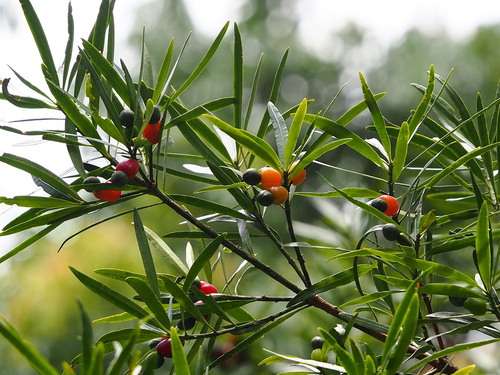
Plum Pines
podocarpus
Plum Pines are tall trees with beautiful green needles that look like they belong in a fairy tale! They produce sweet, plum-like fruits that many animals love to eat.
Lebensraum: Plum Pines are usually found in forests, especially in subtropical and tropical regions.
The Plum Pines is an evergreen conifer with dense, dark green, flattened needle-like leaves. It features distinctive, fleshy, often bright red or purple seed receptacles that resemble small berries, contrasting beautifully with its scaly, grey-brown bark.
Kategorie
PflanzenSeltenheit
Common
Gefahr
0/5 · Keine bekannte Gefahr
Snaps
Mach den ersten Snap!
Despite its name, Plum Pines isn't a true pine; its 'plums' are actually modified cones!
Some Plum Pines have ancient roots, thriving on Earth since the age of dinosaurs!
The tasty part of a Plum Pine seed isn't a fruit, but a fleshy stem called a receptacle!
They are found across continents, hinting at an ancient supercontinent called Gondwana!
Plum Pines has bright, fleshy seed coverings that attract birds and other animals, helping them scatter seeds far and wide for new growth.
Plum Pines can release millions of tiny pollen grains into the wind, allowing them to pollinate other trees across vast distances.
Plum Pines keeps its leaves all year, allowing it to photosynthesize and grow even when other trees have lost their foliage.
Turdus migratorius
eats the fleshy seed receptacle for energy
%2C_Parc_de_Woluw%C3%A9%2C_Brussels_(13042792905).jpg&width=800)
Parus major
nests in its dense foliage and branches
Russula brevipes
forms beneficial root connections for nutrient exchange
Baumbewohnende Tiere leben hauptsächlich in Bäumen und nutzen diese als Unterschlupf, Nahrungsquelle und zum Schutz vor Raubtieren.
Farbenfroh beschreibt Organismen oder Objekte, die eine große Vielfalt an leuchtenden und deutlich erkennbaren Farben aufweisen.
Dieses Merkmal kennzeichnet Lebewesen, deren Ernährung vollständig oder hauptsächlich aus pflanzlichem Material besteht.
Waldlebensräume sind terrestrische Lebensräume, die von dichtem Baumbestand dominiert werden und eine große Vielfalt an Pflanzen- und Tierarten beherbergen.

Tagaktive Tiere sind hauptsächlich bei Tageslicht aktiv und ruhen oder schlafen in der Regel nachts.
Gefahr
0/5 · Keine bekannte Gefahr
Noch keine besonderen Sicherheitshinweise.
1000-3000 cm
300-1000 cm
Frühling
Ja
Leicht
Mehrjährig
Wind
Plum Pines are usually found in forests, especially in subtropical and tropical regions.
Zoome hinein, um Cluster aufzulösen und zu sehen, wo dieses Objekt fotografiert wurde.
Neueste Snaps erscheinen hier, wenn neue Beobachtungen hinzukommen.