

Purple Cress
cardamine douglassii
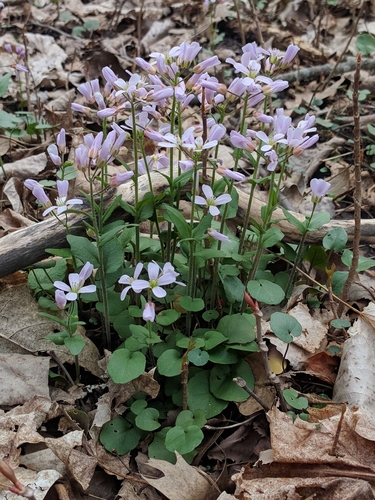
Welcome the spring with the delicate Purple Cress (Cardamine douglassii), also known as the Limestone Bittercress. This charming native perennial is one of the very first wildflowers to carpet the deciduous forest floors of eastern North America as winter recedes. Emerging often while patches of snow still linger, its vibrant, pale pinkish-purple blossoms offer a vital early-season lifeline to awakening native pollinators, bringing a cheerful pop of color to the damp, sleepy woods when most other plants are still dormant. As a true spring ephemeral, Purple Cress completes much of its active life cycle in the brief, sunny window before the forest canopy leafs out, relying on underground rhizomes to persist year after year.
Lebensraum: Found in damp, rich deciduous forests, floodplains, and low calcareous woods, often near limestone outcrops or seeps.
Purple Cress is a low-growing perennial herb reaching 10 to 30 centimeters in height. Its upright, unbranched stems are covered in fine, soft hairs and are crowned by clusters of four-petaled flowers, which range in color from pale lavender and soft pink to a deeper magenta-purple. Each flower features prominent light yellow or purple-tipped anthers at its center. The leaves are variable: basal leaves are rounded and purplish underneath on long petioles, while the stem leaves are alternate, simple, and slightly toothed or wavy along the margins.
Kategorie
PflanzenSeltenheit
Common
Gefahr
1/5 · Sehr gering
Snaps
Mach den ersten Snap!
It is one of the earliest native wildflowers to bloom in eastern North America, sometimes pushing directly through late-season snow cover.
Its scientific genus name, Cardamine, comes from the ancient Greek word for watercress, referencing the bitter, peppery qualities of its foliage.
The leaves of Purple Cress have a mild, peppery flavor similar to watercress or radishes, which is characteristic of the mustard family.
Produces specialized cold-hardy compounds that protect its tissues from freezing, allowing it to bloom during late winter frosts.
Completes its foliage development, flowering, and seed production rapidly in early spring before the overhead forest canopy blocks the sunlight.
Utilizes explosive seedpods that burst open elastically when dry, flinging mature seeds several feet away from the parent plant.
As a photosynthetic plant, Purple Cress manufactures its own energy from carbon dioxide, water, and sunlight, while absorbing essential minerals from the soil.
Pieris virginiensis
The caterpillars of this specialized butterfly feed on the leaves of Purple Cress, which serves as an essential larval host.
Andrena carlini
Early-season mining bees visit the blossoms to forage for pollen and nectar, acting as vital pollinators for the plant.
Odocoileus virginianus
White-tailed deer browse on the fresh spring foliage and flowering stems when other forest vegetation is still scarce.
Für dieses Objekt sind noch keine Merkmal-Badges vergeben.
Noch keine Alternativnamen vorhanden.
Sammlungen für dieses Objekt erscheinen hier, wenn weitere Themen hinzugefügt werden.
Gefahr
1/5 · Sehr gering
Noch keine besonderen Sicherheitshinweise.
Der einfachste Weg, Purple Cress zu bestimmen, ist die Verwendung der Naturführer-App Snappit.
10-30 cm
3-10 Jahre
As a photosynthetic plant, Purple Cress manufactures its own energy from carbon dioxide, water, and sunlight, while absorbing essential minerals from the soil.
Found in damp, rich deciduous forests, floodplains, and low calcareous woods, often near limestone outcrops or seeps.
Zoome hinein, um Cluster aufzulösen und zu sehen, wo dieses Objekt fotografiert wurde.
Neueste Snaps erscheinen hier, wenn neue Beobachtungen hinzukommen.

Ohio, US
Hier kann man sehen Sessiles Dreiblatt und Virginia-Frühlingsstern.
Führer anzeigen →

Indiana, US
Hier kann man sehen Nordamerikanischer Ochsenfrosch.
Führer anzeigen →

Illinois, US
Hier kann man sehen Rotrücken-Salamander und Harbinger Of Spring.
Führer anzeigen →





















