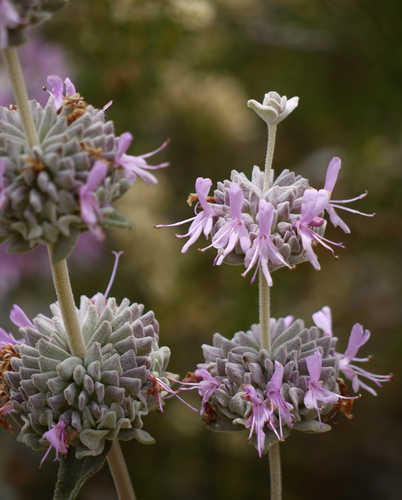


Purple Sage
salvia leucophylla
Purple Sage (Salvia leucophylla) is an aromatic, evergreen shrub native to the coastal hills of southern and central California. Thriving in the harsh, dry conditions of the coastal sage scrub and chaparral plant communities, this resilient plant is celebrated for its stunning visual display and rich, earthy fragrance. During the spring and summer months, it erupts into dense, whorled clusters of light purple to pinkish blossoms, creating a spectacular contrast against its pale, silvery-green foliage. This species plays a foundational role in its native ecosystem, serving as a vital source of nectar for local pollinators and providing essential cover for small wildlife. Its ability to endure prolonged droughts while maintaining its structural beauty has also made it a highly prized choice for water-wise landscaping and xeriscaping across arid regions.
Lebensraum: Found in dry, sunny coastal sage scrub, chaparral, and dry foothill slopes of Southern California and Northern Baja California.
Purple Sage is a medium-sized shrub that typically stands 100 to 150 centimeters tall, occasionally reaching up to 200 centimeters, with a rounded, spreading growth habit. Its key identifying feature is its highly aromatic, oblong-elliptical leaves, which are covered in a dense coat of fine, white hairs, giving the foliage a distinct silvery-green or whitish-gray appearance. The flowers are arranged in dramatic, interrupted whorls along upright spikes, featuring two-lipped, tubular blossoms that range in color from soft lavender to deep rose-purple, nestled within fuzzy, pale calyces.
Kategorie
PflanzenSeltenheit
Common
Gefahr
1/5 · Sehr gering
Snaps
Mach den ersten Snap!
Indigenous peoples, including the Chumash, historically used the leaves of this plant for medicinal teas to treat cold symptoms and for ceremonial smudging.
Purple Sage exhibits allelopathy, releasing volatile chemicals into the soil that suppress the germination and growth of neighboring plant species.
The species name 'leucophylla' translates to 'white-leaved', referencing the light-colored, reflective hairs on its foliage.
Drops some of its larger leaves during dry summer periods to conserve water, relying on smaller, tightly clustered leaves to survive the heat.
Produces volatile terpenes in its leaves that deter herbivores and inhibit the growth of competing plants nearby.
Features a dense covering of tiny white hairs on its leaves that reflect harsh sunlight and trap a layer of humid air, dramatically reducing moisture loss.
As a photoautotrophic plant, Purple Sage synthesizes its own organic nutrients from carbon dioxide and water using sunlight through photosynthesis.
Calypte anna
Pollinates the flowers while foraging for nectar, acting as a key pollinator.
Apis mellifera
Visits flowers to collect nectar and pollen, facilitating cross-pollination.
Strymon melinus
Lays eggs on the plant, and caterpillars feed on the foliage and flower buds.
Für dieses Objekt sind noch keine Merkmal-Badges vergeben.
Noch keine Alternativnamen vorhanden.
Sammlungen für dieses Objekt erscheinen hier, wenn weitere Themen hinzugefügt werden.
Gefahr
1/5 · Sehr gering
Noch keine besonderen Sicherheitshinweise.
Der einfachste Weg, Purple Sage zu bestimmen, ist die Verwendung der Naturführer-App Snappit.
100-200 cm
5-15 Jahre
As a photoautotrophic plant, Purple Sage synthesizes its own organic nutrients from carbon dioxide and water using sunlight through photosynthesis.
Found in dry, sunny coastal sage scrub, chaparral, and dry foothill slopes of Southern California and Northern Baja California.
Photosynthesis
Zoome hinein, um Cluster aufzulösen und zu sehen, wo dieses Objekt fotografiert wurde.
Neueste Snaps erscheinen hier, wenn neue Beobachtungen hinzukommen.

California, US
Hier kann man sehen Westlicher Zaunleguan und Kalifornischer Bruchstrauch.
Führer anzeigen →

California, US
Hier kann man sehen Westlicher Zaunleguan, Ente und Kalifornischer Bruchstrauch.
Führer anzeigen →