

Purple Star-Thistle
centaurea calcitrapa
The Purple Star-Thistle (Centaurea calcitrapa) is a hardy, branching biennial herb famous for its formidable defense mechanisms. Native to the Mediterranean basin, this member of the sunflower family (Asteraceae) has successfully spread to many temperate regions globally, often becoming an aggressive invasive weed. It plays a dual role in ecosystems: while it is notorious for invading agricultural lands, degrading pastures, and crowding out native flora, its flowers provide a vital source of nectar for bees and other pollinators during the late summer months. Its resilient nature allows it to thrive in nutrient-poor, dry, and heavily disturbed soils where other plants struggle. Its scientific name 'calcitrapa' perfectly captures its spiked physical nature, evoking the imagery of medieval spiked caltrops designed to deter cavalry.
Lebensraum: Typically found in dry, disturbed areas such as overgrazed pastures, agricultural fields, waste lands, and sandy roadsides.
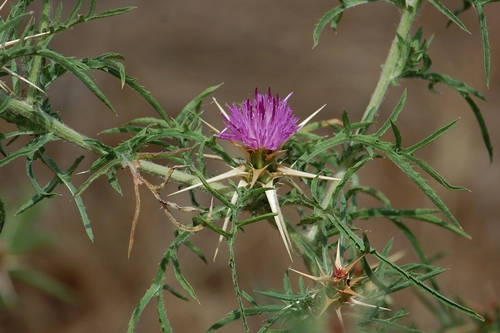
This plant is easily identified by its highly branched, bushy growth form that can reach up to one meter in height. Its most distinctive features are the flower heads: small, pale purple to pinkish florets sitting atop a base heavily armored with stout, sharp, straw-colored spines measuring up to 2.5 centimeters in length. The lower leaves are deeply lobed and form a rosette close to the ground, while the upper leaves are smaller, narrow, and lack lobes, clinging tightly to the tough, ridged, and finely haired stems.
Kategorie
PflanzenSeltenheit
Common
Gefahr
1/5 · Sehr gering
Snaps
Mach den ersten Snap!
Its spines are so formidable that they can injure grazing livestock, often forcing animals to avoid pastures entirely when infestations are heavy.
Purple Star-Thistle seeds have been known to contaminate commercial seed mixes and hay, helping it easily spread across continents.
The species name 'calcitrapa' comes from the Latin word for 'caltrop', a multi-pointed iron weapon used in medieval warfare to obstruct horses, referring to the plant's painfully sharp spines.
The flower heads are surrounded by incredibly sharp, rigid spines that deter grazing herbivores and protect the developing seeds.
A robust, deep taproot allows the plant to access moisture and nutrients deep in the soil, ensuring survival during hot, dry summer droughts.
A single plant can produce thousands of seeds that can remain dormant and viable in the soil for several years, waiting for ideal growth conditions.
As a photoautotrophic plant, it manufactures its own energy from sunlight, water, and carbon dioxide through photosynthesis.
Chaetorellia acrolophi
The larvae of this fly feed on the seeds inside the flower heads, making it a biological control agent.
Apis mellifera
Bees pollinate the purple flowers while foraging for abundant nectar and pollen.
Centaurea solstitialis
Competes aggressively with the purple star-thistle for space, water, and soil nutrients in dry pastures.
Für dieses Objekt sind noch keine Merkmal-Badges vergeben.
Noch keine Alternativnamen vorhanden.
Sammlungen für dieses Objekt erscheinen hier, wenn weitere Themen hinzugefügt werden.
Gefahr
1/5 · Sehr gering
Noch keine besonderen Sicherheitshinweise.
Der einfachste Weg, Purple Star-Thistle zu bestimmen, ist die Verwendung der Naturführer-App Snappit.
20-100 cm
1-2 Jahre
As a photoautotrophic plant, it manufactures its own energy from sunlight, water, and carbon dioxide through photosynthesis.
Typically found in dry, disturbed areas such as overgrazed pastures, agricultural fields, waste lands, and sandy roadsides.
Zoome hinein, um Cluster aufzulösen und zu sehen, wo dieses Objekt fotografiert wurde.
Neueste Snaps erscheinen hier, wenn neue Beobachtungen hinzukommen.