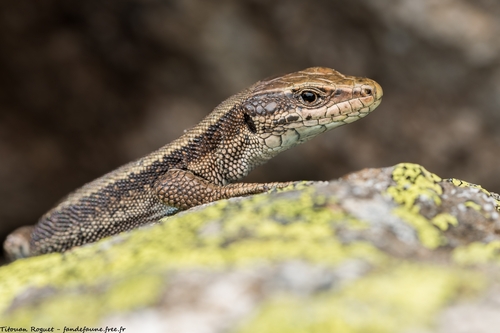


Pyrenean Rock Lizard
iberolacerta bonnali
The Pyrenean Rock Lizard (Iberolacerta bonnali) is a resilient and fascinating reptile that makes its home in the harsh, high-altitude alpine zones of the Pyrenees mountains. Perfectly adapted to survival in extreme cold, this small lizard thrives where few other reptiles dare to venture. It is typically found basking on sun-warmed granite rocks near mountain lakes and scree slopes, often at altitudes exceeding 2,000 meters. Because of its brief active season—limited to the short summer months—the Pyrenean Rock Lizard displays remarkable energy efficiency and timing. Watching this agile climber navigate vertical rock faces with precision is a delight for high-altitude hikers and herpetologists alike. It stands as a testament to life's adaptability in Europe's most challenging mountain landscapes.
Lebensraum: Found exclusively on alpine scree slopes, rocky outcrops, and stone walls near water bodies at high elevations in the Pyrenees.
This is a relatively small lizard, measuring about 12 to 20 cm in total length, with a long, slender tail that can double its snout-vent length. It features a flattened body shape that allows it to squeeze into tight rocky crevices. Its coloration is highly cryptic, consisting of a grayish-brown or olive-colored back adorned with two dark lateral bands and subtle speckling. Unlike some other rock lizards, its belly is typically white, gray, or pale yellow, lacking bright green or orange hues, and it has smooth, non-keeled scales that give it a slightly glossy appearance.
Kategorie
ReptilienSeltenheit
Common
Gefahr
1/5 · Sehr gering
Snaps
Mach den ersten Snap!
Because they live in cold environments, they spend a large portion of their active day thermoregulating on rocks before they have enough energy to hunt.
Its scientific name, bonnali, honors the French naturalist Count de Bonnal, who collected the first specimens in the early 20th century.
This species spends up to eight months of the year in deep hibernation beneath the snow and rock layers.
These lizards can survive sub-zero temperatures during winter hibernation by producing cryoprotective compounds in their bodies.
With a dorsoventrally flattened body and flexible skeleton, they can easily squeeze into tiny rock fractures to escape predators.
If grabbed by a predator, the lizard can self-amputate its tail, which continues to wiggle to distract the threat while the lizard escapes.
Feeds opportunistically on a wide variety of small alpine invertebrates, taking advantage of the brief summer abundance of insects and arachnids.
Altersunterschiede: Juveniles eat smaller prey, such as mites and tiny flies, due to their smaller gape size.
Pardosa mixta
Preys heavily on this spider species in alpine meadows.
Vipera berus
Preys on the Pyrenean Rock Lizard, capturing them while they bask on rocks.
Podarcis muralis
Competes for basking sites and insect prey in overlapping high-altitude ranges.
Für dieses Objekt sind noch keine Merkmal-Badges vergeben.
Noch keine Alternativnamen vorhanden.
Sammlungen für dieses Objekt erscheinen hier, wenn weitere Themen hinzugefügt werden.
Gefahr
1/5 · Sehr gering
Noch keine besonderen Sicherheitshinweise.
Der einfachste Weg, Pyrenean Rock Lizard zu bestimmen, ist die Verwendung der Naturführer-App Snappit.
12-20 cm
0.004-0.009 kg
8-15 Jahre
8 km/h
Feeds opportunistically on a wide variety of small alpine invertebrates, taking advantage of the brief summer abundance of insects and arachnids.
Found exclusively on alpine scree slopes, rocky outcrops, and stone walls near water bodies at high elevations in the Pyrenees.
Foraging
Zoome hinein, um Cluster aufzulösen und zu sehen, wo dieses Objekt fotografiert wurde.
Neueste Snaps erscheinen hier, wenn neue Beobachtungen hinzukommen.

















_male_(Found_by_Jean_NICOLAS)_(14086101473).jpg&width=800)
