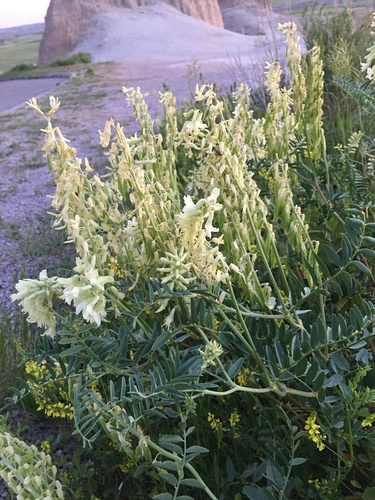


Racemose Milkvetch
astragalus racemosus
Racemose Milkvetch (Astragalus racemosus) is a robust, perennial wildflower native to the open prairies and badlands of central and western North America. Belonging to the diverse Fabaceae family, this species is highly specialized to thrive in soils that many other plants find inhospitable. It is famously classified as a selenium hyperaccumulator, meaning it actively draws up large concentrations of selenium from the ground, storing it within its tissues. While this adaptation renders the plant highly toxic to grazing livestock, it serves as a critical defense mechanism against hungry herbivores in the wild. This fascinating survival strategy makes it a key subject of ecological study. Its dense, drooping clusters of creamy-white flowers provide crucial nectar for native bumblebees, demonstrating its complex role as both a localized hazard and an ecological partner.
Lebensraum: Found on open prairies, plains, clay badlands, and roadsides, typically growing in heavy, clay-rich soils high in selenium or gypsum.
This upright perennial typically grows between 30 to 100 centimeters tall, forming leafy clumps with sturdy, sometimes reddish-purple stems. Its leaves are pinnately compound, divided into numerous narrow, oblong leaflets of a grayish-green hue. The most distinguishing feature is the dense, one-sided clusters (racemes) of tubular, pea-like flowers. These blossoms are creamy-white to pale yellow, measuring about 1.5 to 2 centimeters long, and they hang gracefully downward from long stalks. After flowering, the plant produces swollen, triangular seed pods that dry to a light brown color.
Kategorie
PflanzenSeltenheit
Common
Gefahr
1/5 · Sehr gering
Snaps
Mach den ersten Snap!
Because it only grows in soils rich in selenium, uranium prospectors historically used the presence of this plant to locate uranium-bearing geological formations.
It is highly toxic to horses and cattle, causing a chronic poisoning known as 'alkali disease' or 'blind staggers,' which leads to hair loss and hoof deformities.
When bruised or growing in hot weather, the plant releases a strong, garlic-like odor due to its high concentration of volatile selenium compounds.
Actively absorbs and concentrates selenium from the soil, making its tissues toxic to herbivores and reducing competition from sensitive plants nearby.
Partners with specialized underground rhizobia bacteria to convert atmospheric nitrogen into nutrients, enriching poor prairie soils.
Employs a deep, robust woody taproot that anchors the plant and accesses deep water reserves in arid grasslands.
As a photosynthetic autotroph, it synthesizes its own sugars using sunlight, carbon dioxide, and water while absorbing essential minerals from the soil.
Rhizobium leguminosarum
Forms a mutualistic relationship in the root nodules to convert atmospheric nitrogen into usable ammonia.
Bombus huntii
Feeds on the nectar of the flowers while acting as a primary pollinator.
Acanthoscelides aureolus
Larvae of this beetle feed directly on the developing seeds inside the woody pods.
Für dieses Objekt sind noch keine Merkmal-Badges vergeben.
Noch keine Alternativnamen vorhanden.
Sammlungen für dieses Objekt erscheinen hier, wenn weitere Themen hinzugefügt werden.
Gefahr
1/5 · Sehr gering
Noch keine besonderen Sicherheitshinweise.
Der einfachste Weg, Racemose Milkvetch zu bestimmen, ist die Verwendung der Naturführer-App Snappit.
30-100 cm
3-10 Jahre
As a photosynthetic autotroph, it synthesizes its own sugars using sunlight, carbon dioxide, and water while absorbing essential minerals from the soil.
Found on open prairies, plains, clay badlands, and roadsides, typically growing in heavy, clay-rich soils high in selenium or gypsum.
Zoome hinein, um Cluster aufzulösen und zu sehen, wo dieses Objekt fotografiert wurde.
Neueste Snaps erscheinen hier, wenn neue Beobachtungen hinzukommen.





_001.jpg&width=800)