






Ravine Salamander
Plethodon richmondi
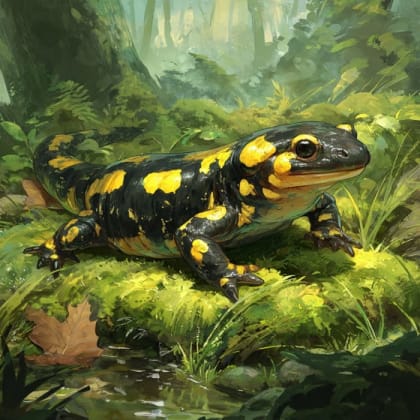
The Ravine Salamander is a small, colorful creature that loves to hide under rocks and leaves. It has smooth skin and can be found in cool, moist places. These little salamanders are fun to spot in the wild!
Lebensraum: Forests
The Ravine Salamander is a slender, dark-bodied amphibian, typically black or dark brown. It has two narrow, often gray or bronze, parallel stripes running down its back. Its tiny limbs and long tail differentiate it from many other salamanders.
Kategorie
AmphibienSeltenheit
Common
Gefahr
1/5 · Sehr gering
Snaps
Mach den ersten Snap!
Ravine salamanders are completely terrestrial; they never enter water, even to lay their eggs!
Ravine salamanders can live for over 10 years, a long time for a tiny, lungless amphibian!
These shy creatures are nocturnal, meaning they are most active exploring under moonlight!
They are part of a special group of salamanders that don't have lungs at all!
Ravine Salamander can breathe entirely through its moist skin and mouth lining, allowing it to thrive in damp, low-oxygen spots.
Ravine Salamander can shed its tail when grabbed by a predator, giving it a chance to escape to safety while the tail wiggles.
Ravine Salamander has glands that secrete a sticky, mild toxin, making them unpleasant for predators to try and eat.
They munch on tiny insects and other small creepy crawlies found hidden in damp soil and leaf litter.
Diadophis punctatus
A common predator in their woodland habitat.
Sorex cinereus
Shrews are opportunistic predators of small amphibians.
Orchesella cincta
A tiny insect they forage for in leaf litter.
Staphylinus erythropterus
Larvae and adults of small beetles are part of their diet.
Einzelgänger leben den größten Teil ihres Lebens allein und interagieren mit Artgenossen nur zur Paarung oder zur Aufzucht der Jungen.
Farbenfroh beschreibt Organismen oder Objekte, die eine große Vielfalt an leuchtenden und deutlich erkennbaren Farben aufweisen.
Getarnt beschreibt Organismen, die über eine Färbung oder Musterung verfügen, durch die sie mit ihrer Umgebung verschmelzen.
Dieses Merkmal kennzeichnet Organismen, deren Nahrung hauptsächlich aus Insekten und anderen kleinen Wirbellosen besteht.

Waldlebensräume sind terrestrische Lebensräume, die von dichtem Baumbestand dominiert werden und eine große Vielfalt an Pflanzen- und Tierarten beherbergen.

Beschreibt Organismen, die totes organisches Material abbauen und Nährstoffe in das Ökosystem zurückführen.

Regenerationsfähige Organismen besitzen die Fähigkeit, verlorene oder beschädigte Körperteile, Gewebe oder Organe nachwachsen zu lassen.

Nachtaktive Tiere sind hauptsächlich in den Nachtstunden aktiv und ruhen oder schlafen normalerweise tagsüber.

Der Status 'Stark gefährdet' bedeutet, dass eine Art in naher Zukunft einem sehr hohen Risiko ausgesetzt ist, in freier Wildbahn auszusterben.
Noch keine Alternativnamen vorhanden.
Gefahr
1/5 · Sehr gering
If you see a salamander, be gentle and don’t pick it up too much. They are delicate creatures!
8-12 cm
0.002-0.005 kg
5-10 Jahre
0.5 km/h
They munch on tiny insects and other small creepy crawlies found hidden in damp soil and leaf litter.
Forests
Foraging
3-17
Zoome hinein, um Cluster aufzulösen und zu sehen, wo dieses Objekt fotografiert wurde.
Neueste Snaps erscheinen hier, wenn neue Beobachtungen hinzukommen.







.jpg&width=800)



_-_1.jpg&width=800)

