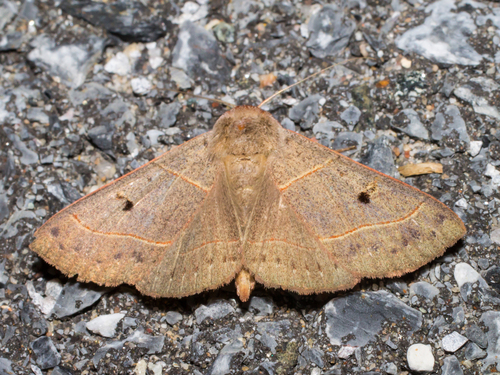


Red-Lined Panopoda Moth
panopoda rufimargo
The Red-Lined Panopoda Moth (Panopoda rufimargo) is a beautifully cryptic member of the Erebidae family, commonly found throughout the deciduous forests of eastern North America. Renowned for its subtle elegance, this moth exhibits a warm coloration that mimics fallen autumn leaves, allowing it to blend seamlessly into the forest floor or tree bark during the day. While it might look unassuming at first glance, a closer inspection reveals striking, clean reddish-orange lines running across its forewings, earning it its evocative common name.
Lebensraum: Found in deciduous and mixed woodlands, particularly in areas rich with oak, maple, and beech trees.
This medium-sized moth features a wingspan of 3 to 5 cm. Its forewings are typically tan, yellowish-brown, or light orange-gray, marked by two prominent, relatively straight postmedial and antemedial lines colored in distinct reddish-orange or yellow. A soft pinkish or reddish tint often shades the outer wing margin, and small dark spots or smudges are usually visible near the center of each forewing.
Kategorie
InsektenSeltenheit
Common
Gefahr
1/5 · Sehr gering
Snaps
Mach den ersten Snap!
The caterpillars are incredibly flat and lack prominent back humps, allowing them to appear like a natural, flat extension of a leafy twig.
The species name 'rufimargo' translates directly to 'red-bordered,' referencing the thin, bright lines on its forewings.
Unlike many species of moths that strictly stick to one food plant, the Red-Lined Panopoda can successfully rear on several different types of hardwood trees.
Both the larvae and adult moths possess colors and physical shapes that expertly mimic green leaves or decaying forest floor litter to avoid detection.
Utilizes highly sensitive compound eyes and chemical receptors to navigate dense woodland canopies in near-total darkness.
The caterpillars have flattened bodies with fringed sides, allowing them to press flat against twigs to eliminate shadows that would give away their position to predators.
The caterpillars are voracious folivores feeding on the leaves of deciduous hardwood trees, while adult moths primarily feed on tree sap and plant exudates.
Altersunterschiede: Larvae chew and consume solid leaf tissues of host trees, whereas adults transition to a purely liquid diet consisting of tree sap, dew, and rotting fruit sugars.
Quercus alba
The larvae feed on the foliage of this oak tree as their primary nursery host plant.
Cyanocitta cristata
This bird commonly searches branches and tree trunks to hunt larvae and adult moths.
Fagus grandifolia
The caterpillar utilizes the leaves of this hardwood tree as an alternative nutritional source.
Für dieses Objekt sind noch keine Merkmal-Badges vergeben.
Noch keine Alternativnamen vorhanden.
Sammlungen für dieses Objekt erscheinen hier, wenn weitere Themen hinzugefügt werden.
Gefahr
1/5 · Sehr gering
Noch keine besonderen Sicherheitshinweise.
Der einfachste Weg, Red-Lined Panopoda Moth zu bestimmen, ist die Verwendung der Naturführer-App Snappit.
0.0001+ kg
15 km/h
The caterpillars are voracious folivores feeding on the leaves of deciduous hardwood trees, while adult moths primarily feed on tree sap and plant exudates.
Found in deciduous and mixed woodlands, particularly in areas rich with oak, maple, and beech trees.
Foraging
Zoome hinein, um Cluster aufzulösen und zu sehen, wo dieses Objekt fotografiert wurde.
Neueste Snaps erscheinen hier, wenn neue Beobachtungen hinzukommen.












