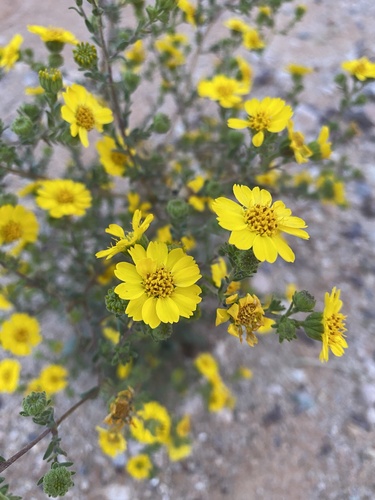


Red Rock Tarplant
deinandra arida
The Red Rock Tarplant (Deinandra arida) is an incredibly rare and resilient wildflower native to the harsh desert environments of California. Endemic to a very small region within Kern County, particularly Red Rock Canyon State Park, this species has adapted to survive in barren badlands and volcanic tuff where few other plants can persist. Its name comes from the sticky, aromatic resin secreted by its glands, which coats the plant and protects it from intense desert heat and thirsty herbivores. As a member of the aster family, it produces cheerful yellow flower heads that brighten the desert landscape when in bloom. Finding this botanical gem in its natural rugged habitat is a special treat for any plant enthusiast or hiker exploring the Mojave Desert.
Lebensraum: Found exclusively on volcanic tuff, sandstone cliffs, and clay-rich badlands within desert canyon ecosystems.
This annual herb grows between 10 to 90 centimeters tall, featuring slender, highly branched stems covered in sticky, glandular hairs. Its narrow, green leaves are linear and emit a strong, resinous odor when touched. During its blooming period, it displays small, daisy-like flower heads consisting of bright yellow ray florets and matching yellow disk florets, giving the entire plant a golden, sun-kissed appearance against the red desert rocks.
Kategorie
PflanzenSeltenheit
Common
Gefahr
1/5 · Sehr gering
Snaps
Mach den ersten Snap!
Despite growing in near-barren sandstone and volcanic ash where other plants wither, it produces beautiful, vibrant yellow blossoms.
It is a micro-endemic species, meaning its global distribution is limited to an incredibly small, specific pocket of the California desert.
The sticky resin produced by this plant smells strongly of tar or turpentine, a unique defense mechanism that deters hungry desert herbivores.
Produces a dense coating of sticky, aromatic resin that acts as a physical barrier against herbivores and significantly reduces moisture loss.
Possesses a specialized root system capable of anchoring deep into solid rock crevices and clay, extracting scarce moisture from arid substrates.
Utilizes glandular trichomes to diffuse intense sunlight, protecting cellular structures from extreme desert heat and UV radiation.
As a photoautotrophic plant, it synthesizes its own food using sunlight, water, carbon dioxide, and essential soil minerals.
Apis mellifera
Pollinates the flowers while gathering nectar and pollen, ensuring successful plant reproduction.
Chaetodipus penicillatus
Forages on the fallen seeds of the tarplant as a source of energy in the arid desert.
Anisocoma acaulis
Competes for limited soil moisture and space in sandy desert washes.
Für dieses Objekt sind noch keine Merkmal-Badges vergeben.
Noch keine Alternativnamen vorhanden.
Sammlungen für dieses Objekt erscheinen hier, wenn weitere Themen hinzugefügt werden.
Gefahr
1/5 · Sehr gering
Noch keine besonderen Sicherheitshinweise.
Der einfachste Weg, Red Rock Tarplant zu bestimmen, ist die Verwendung der Naturführer-App Snappit.
10-90 cm
1 Jahre
As a photoautotrophic plant, it synthesizes its own food using sunlight, water, carbon dioxide, and essential soil minerals.
Found exclusively on volcanic tuff, sandstone cliffs, and clay-rich badlands within desert canyon ecosystems.
Zoome hinein, um Cluster aufzulösen und zu sehen, wo dieses Objekt fotografiert wurde.
Neueste Snaps erscheinen hier, wenn neue Beobachtungen hinzukommen.

California, US
Hier kann man sehen Sand Blazingstar, Red Rock Tarplant und Rainfarn-Phazelie.
Führer anzeigen →

California, US
Hier kann man sehen Red Rock Tarplant und Red Rock Canyon Monkeyflower.
Führer anzeigen →















