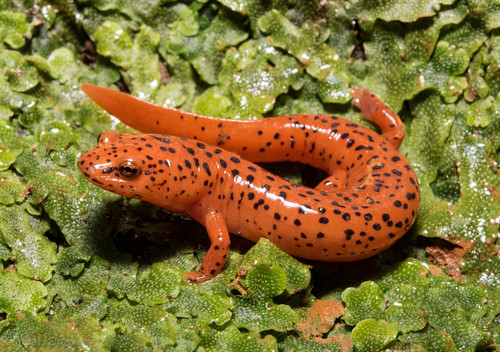


Red Salamander
pseudotriton ruber
The Red Salamander (Pseudotriton ruber) is a striking and charismatic amphibian native to the eastern forests of the United States. Belonging to the family Plethodontidae, this remarkable creature is entirely lungless, relying instead on its moist, highly vascularized skin and the lining of its mouth to breathe. They are typically found in or near clean, cool woodland springs, seepages, and rocky streams, where they play a vital role as mid-level predators. Their brilliant coloration serves as a warning to potential predators of their noxious skin secretions, making them a fascinating subject for wildlife enthusiasts. Despite their vibrant appearance, they are secretive animals that spend much of their lives hidden beneath logs, stones, and leaf litter. Encountering one of these vibrant salamanders is a highlight for any nature spotter, offering a glimpse into the pristine freshwater ecosystems they inhabit and depend upon.
Lebensraum: Found near cool, clean springs, seepages, and mountain streams, often hiding beneath rocks, logs, or leaf litter in moist deciduous forests.
The Red Salamander is characterized by its robust, stocky body and a short, thick tail, typically reaching lengths between 10 and 18 cm. Its most defining feature is its brilliant coral-red to reddish-orange background color, which is generously peppered with numerous irregular, small black spots along its back and sides. As these salamanders age, their vibrant red coloration gradually darkens into a deeper purplish-brown or dusky-orange. They feature bright yellow or golden irises and lack the distinct nasolabial groove markings found in some look-alike species, helping to distinguish them from the closely related Mud Salamander.
Kategorie
AmphibienSeltenheit
Common
Gefahr
1/5 · Sehr gering
Snaps
Mach den ersten Snap!
As Red Salamanders age, their vibrant red color darkens, eventually turning a deep purplish-brown.
Despite their highly aquatic larval stage, adults can wander far into upland forest habitats during wet weather.
They participate in a mimicry complex with the highly toxic red eft stage of the Eastern Newt to deter predators.
Lacking lungs completely, they absorb oxygen and release carbon dioxide entirely through their moist, specialized skin and mouth lining.
They possess a highly specialized, free-ended tongue that can be rapidly launched out of the mouth to capture prey in milliseconds.
Their skin glands secrete noxious, foul-tasting chemicals that protect them from avian and mammalian predators.
An opportunistic forest-floor predator that consumes a wide variety of small invertebrates and occasionally smaller amphibians.
Altersunterschiede: Aquatic larvae feed primarily on tiny aquatic invertebrates like copepods and midge larvae, while terrestrial adults consume larger insects, earthworms, and small amphibians.
Lumbricus terrestris
Preys heavily on this abundant forest-floor earthworm.
Thamnophis sirtalis
Actively preys upon young, larval, or smaller adult Red Salamanders in shared riparian habitats.
Pseudotriton montanus
Competes for food resources and microhabitats in damp, swampy areas.
Für dieses Objekt sind noch keine Merkmal-Badges vergeben.
Noch keine Alternativnamen vorhanden.
Sammlungen für dieses Objekt erscheinen hier, wenn weitere Themen hinzugefügt werden.
Gefahr
1/5 · Sehr gering
Noch keine besonderen Sicherheitshinweise.
Der einfachste Weg, Red Salamander zu bestimmen, ist die Verwendung der Naturführer-App Snappit.
10+ cm
0.007+ kg
10+ Jahre
An opportunistic forest-floor predator that consumes a wide variety of small invertebrates and occasionally smaller amphibians.
Found near cool, clean springs, seepages, and mountain streams, often hiding beneath rocks, logs, or leaf litter in moist deciduous forests.
Ambush
50+
Zoome hinein, um Cluster aufzulösen und zu sehen, wo dieses Objekt fotografiert wurde.
Neueste Snaps erscheinen hier, wenn neue Beobachtungen hinzukommen.




.jpg&width=800)












