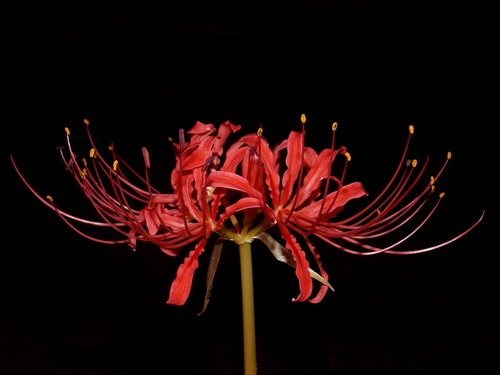


Red Spider Lily
lycoris radiata
The Red Spider Lily (Lycoris radiata) is a breathtakingly beautiful perennial plant famous for its brilliant crimson blooms that emerge like clockwork in late summer and autumn. Often associated with legends, transitions, and the arrival of autumn in East Asia, this striking wildflower is known for its unique growth cycle where flowers and leaves never meet. The bright red petals burst forth on tall, naked stems, creating a dramatic visual display in gardens, along roadsides, and near temples. Once the flowers fade, the strap-like green leaves finally emerge to gather energy throughout the winter. Highly resilient and rich in cultural symbolism, the Red Spider Lily is both a beloved ornamental plant and a fascinating botanical wonder that thrives with minimal care.
Lebensraum: Typically found growing in moist, well-drained soils along forest edges, riversides, grassy slopes, and agricultural pathways, particularly near rice paddies in East Asia.
This plant is instantly recognizable by its vibrant, coral-red flowers featuring narrow, backward-curving petals and exceptionally long, thread-like stamens that flare outward like spider legs. The blossoms are arranged in a spectacular, umbrella-like cluster at the peak of a smooth, leafless grayish-green stem that grows up to 30 to 60 cm tall. Because the plant blooms before its foliage appears, the flowers stand alone in stark, dramatic contrast against the bare earth or green grasses, while the dark green, ribbon-like leaves only appear after the blooms have completely died back.
Kategorie
PflanzenSeltenheit
Common
Gefahr
1/5 · Sehr gering
Snaps
Mach den ersten Snap!
According to Buddhist legend, these flowers grow along the paths to the afterlife, helping to guide departing souls to reincarnation.
Because the bulbs are poisonous, Japanese farmers historically planted them along the edges of rice paddies to keep moles and mice away.
In Japan, the Red Spider Lily is known as 'Higanbana' (flower of the equinox) and is deeply associated with Buddhist autumn equinox celebrations.
The plant produces flowers and leaves at entirely different times of the year, preventing them from ever appearing together.
The bulbs contain lycorine, a highly toxic alkaloid that deters underground pests, rodents, and grazing herbivores from eating them.
Following late summer rains, the flowering stems shoot up from dormant underground bulbs with astonishing speed, blooming within just a few days.
As a photosynthetic plant, the Red Spider Lily produces its own food using sunlight, water, carbon dioxide, and soil nutrients.
Papilio machaon
Adult swallowtails visit the bright red flowers to feed on nectar, transferring pollen in the process.
Apis cerana
Gathers nectar from the late-blooming flowers and assists in pollination.
Merodon equestris
The larvae of this fly can sometimes parasitize and feed on the toxic bulbs of Lycoris species.
Für dieses Objekt sind noch keine Merkmal-Badges vergeben.
Noch keine Alternativnamen vorhanden.
Sammlungen für dieses Objekt erscheinen hier, wenn weitere Themen hinzugefügt werden.
Gefahr
1/5 · Sehr gering
Noch keine besonderen Sicherheitshinweise.
Der einfachste Weg, Red Spider Lily zu bestimmen, ist die Verwendung der Naturführer-App Snappit.
30-60 cm
0.1-0.3 kg
5-20 Jahre
As a photosynthetic plant, the Red Spider Lily produces its own food using sunlight, water, carbon dioxide, and soil nutrients.
Typically found growing in moist, well-drained soils along forest edges, riversides, grassy slopes, and agricultural pathways, particularly near rice paddies in East Asia.
Zoome hinein, um Cluster aufzulösen und zu sehen, wo dieses Objekt fotografiert wurde.
Neueste Snaps erscheinen hier, wenn neue Beobachtungen hinzukommen.




_Hibiscus_moscheutos_-_Red_swamp_rose-mallow_flower_-_Les_Martels%2C_Giroussens_Tarn.jpg&width=800)











_Malva_parviflora_-_Habitus.jpg&width=800)

