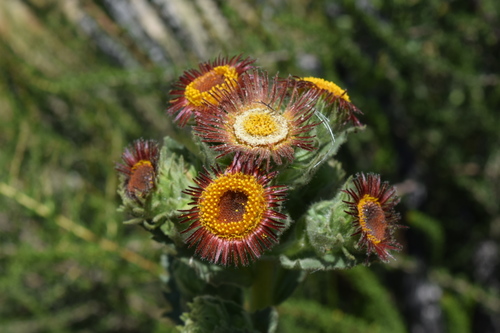


Redray Alpinegold
hulsea heterochroma
The Redray Alpinegold (Hulsea heterochroma) is an eye-catching, robust wildflower native to the mountain ranges of the western United States. Standing tall on sturdy, resinous stems, this member of the sunflower family is particularly renowned for its affinity for disturbed soils and post-wildfire ecological niches. In the years following a forest fire, slopes that once seemed barren can burst into vibrant displays of these brilliant yellow and red blooms, acting as a crucial early pioneer species in forest regeneration. Its glandular foliage releases a strong, spicy aroma when brushed, a characteristic trait that adds to the sensory experience of encountering it along montane trails. It provides essential nectar and pollen for native insects, making it a cornerstone of high-altitude ecosystems.
Lebensraum: Found on rocky slopes, talus, and open montane coniferous forests, often thriving in recently burned chaparral or forest clearings.
This stout, perennial herb typically grows between 30 and 100 cm tall, supported by thick, upright stems coated in sticky, glandular hairs. Its dark green, oblanceolate leaves have coarsely toothed margins and a slightly wrinkled texture. The defining feature is the impressive flower head, which spans up to 5 to 8 cm across. It features a center of bright yellow disc florets surrounded by numerous narrow ray florets that exhibit a striking gradient from golden yellow near the center to vivid reddish-pink or orange at the tips, giving the plant its distinct 'redray' moniker.
Kategorie
PflanzenSeltenheit
Common
Gefahr
1/5 · Sehr gering
Snaps
Mach den ersten Snap!
Because it flourishes immediately after fires, it is considered a key fire-follower plant in Sierra Nevada ecology.
The genus name 'Hulsea' honors George W. Hulse, a 19th-century US Army surgeon and botanical collector.
The resin on its leaves has a strong, pine-like herbaceous scent that can linger on clothes and fingers after touching.
Its seeds possess a dormancy mechanism that is broken by compounds in smoke and the heat of wildfires, allowing it to colonize recently burned areas rapidly.
The entire plant is covered in sticky, resinous hairs that secrete unpalatable compounds, protecting it from browsing herbivores and minimizing moisture loss.
The red anthocyanin pigments in its ray florets protect the plant's reproductive structures from intense ultraviolet radiation at high elevations.
As an autotrophic plant, the Redray Alpinegold generates its own energy through photosynthesis, converting sunlight, water, and carbon dioxide into sugars.
Bombus vosnesenskii
Pollinated by native bees seeking pollen and nectar.
Euphydryas chalcedona
Foraged upon by caterpillars of various native brush-footed butterfly species.
Emmenanthe penduliflora
Competes with other post-fire herbaceous plants for soil nutrients and sunlight.
Für dieses Objekt sind noch keine Merkmal-Badges vergeben.
Noch keine Alternativnamen vorhanden.
Sammlungen für dieses Objekt erscheinen hier, wenn weitere Themen hinzugefügt werden.
Gefahr
1/5 · Sehr gering
Noch keine besonderen Sicherheitshinweise.
Der einfachste Weg, Redray Alpinegold zu bestimmen, ist die Verwendung der Naturführer-App Snappit.
30-100 cm
0.05-0.4 kg
2-5 Jahre
As an autotrophic plant, the Redray Alpinegold generates its own energy through photosynthesis, converting sunlight, water, and carbon dioxide into sugars.
Found on rocky slopes, talus, and open montane coniferous forests, often thriving in recently burned chaparral or forest clearings.
Photosynthesis
Zoome hinein, um Cluster aufzulösen und zu sehen, wo dieses Objekt fotografiert wurde.
Neueste Snaps erscheinen hier, wenn neue Beobachtungen hinzukommen.














