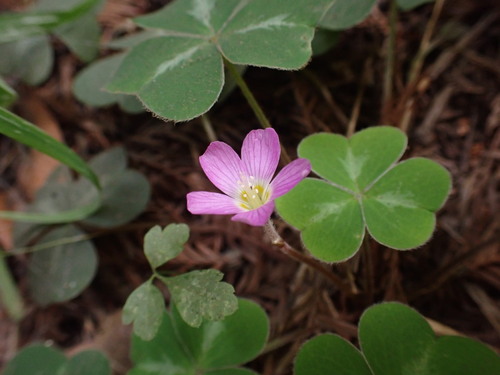


Redwood Sorrel
oxalis smalliana
Redwood Sorrel (Oxalis smalliana), also known as Small's woodsorrel, is an elegant perennial herb that flourishes on the damp, shaded floors of temperate forests. Famous for its delicate clover-like leaves, this plant forms lush, velvety carpets under dense forest canopies where direct sunlight rarely penetrates. It has evolved a highly sensitive nature: when exposed to intense light or dry conditions, its leaflets fold neatly downward to conserve precious moisture and protect its photosynthetic machinery, only to reopen when gentle shade returns. During the spring and summer months, it produces small, pristine white to light pink five-petaled blossoms that stand out brilliantly against the dark forest floor. This resilient understory species plays a critical role in stabilizing forest soils and maintaining understory humidity, making it a key component of its native woodland ecosystems.
Lebensraum: Typically found in moist, deeply shaded temperate woodlands and mountain valleys, thriving on humus-rich soils near forest streams.
Redwood Sorrel features clusters of three heart-shaped leaflets, each about 1 to 3 centimeters wide, connected to delicate, reddish-green petioles rising directly from underground rhizomes. The leaves are a vibrant emerald green on top, sometimes showing a lighter chevron pattern, while their undersides can carry a subtle purplish tint. Its solitary, cup-shaped flowers measure roughly 1.5 to 2 centimeters across and consist of five overlapping petals. These petals are white to pale lavender-pink, decorated with fine, darker pink veins that converge toward a bright yellow center.
Kategorie
PflanzenSeltenheit
Common
Gefahr
1/5 · Sehr gering
Snaps
Mach den ersten Snap!
It spreads effectively through underground rhizomes, allowing a single plant to form vast, interconnected clonal colonies over time.
Its rapid leaf-folding reaction is a form of rapid plant movement, triggered by changes in turgor pressure within specialized cell joints called pulvini.
The plant contains oxalic acid, which gives its leaves a tart, green-apple flavor often compared to sorrel, though consuming large amounts can be toxic.
The leaves fold downward along their center vein during intense sunlight or at night to minimize water loss and protect delicate leaf tissue.
It can efficiently carry out photosynthesis in low-light environments, utilizing less than one percent of direct sunlight.
Accumulates high concentrations of oxalic acid in its cells, giving the plant a sour taste that deters many generalist herbivores.
As a photoautotroph, it produces its own energy by capturing sunlight and converting carbon dioxide and water into sugars.
Cryptomeria japonica
Provides the dense canopy shade and acidic leaf litter necessary for the sorrel to thrive.
Cervus nippon
Occasionally grazes on the leaves as a minor part of its herbaceous diet.
Apis cerana
Visits the spring blossoms to collect nectar, acting as a primary pollinator.
Für dieses Objekt sind noch keine Merkmal-Badges vergeben.
Noch keine Alternativnamen vorhanden.
Sammlungen für dieses Objekt erscheinen hier, wenn weitere Themen hinzugefügt werden.
Gefahr
1/5 · Sehr gering
Noch keine besonderen Sicherheitshinweise.
Der einfachste Weg, Redwood Sorrel zu bestimmen, ist die Verwendung der Naturführer-App Snappit.
5-15 cm
3-8 Jahre
As a photoautotroph, it produces its own energy by capturing sunlight and converting carbon dioxide and water into sugars.
Typically found in moist, deeply shaded temperate woodlands and mountain valleys, thriving on humus-rich soils near forest streams.
Zoome hinein, um Cluster aufzulösen und zu sehen, wo dieses Objekt fotografiert wurde.
Neueste Snaps erscheinen hier, wenn neue Beobachtungen hinzukommen.

California, US
Hier kann man sehen Redwood Sorrel, Küstenmammutbaum und Button's Banana Slug.
Führer anzeigen →

California, US
Hier kann man sehen Küstenmammutbaum und Pazifische Dreiblattblume.
Führer anzeigen →

US
Hier kann man sehen Button's Banana Slug, Ochre Sea Star und Bat Star.
Führer anzeigen →










