

Relict Trillium
trillium reliquum
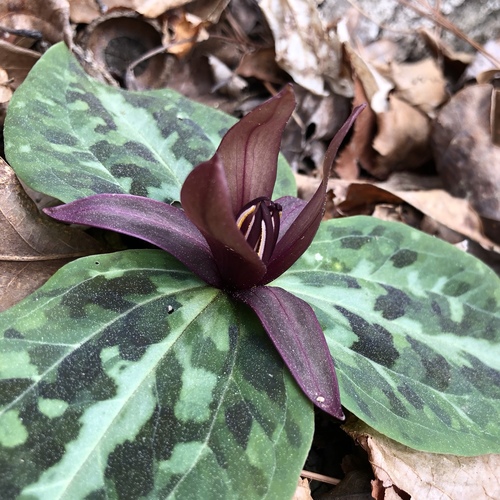
The Relict Trillium (Trillium reliquum) is an exceptionally rare and fascinating herbaceous plant found exclusively in the southeastern United States. True to its name, it is considered a "relict" species—a lingering survivor from ancient, undisturbed deciduous forests that once blanketed the region before large-scale land clearing. What makes this plant particularly endearing is its unusual growth habit; rather than standing upright like most of its relatives, the Relict Trillium's stem gracefully snakes along the ground, displaying its beautifully mottled leaves right against the forest floor. As a spring ephemeral, the Relict Trillium bursts into life in the early spring, capturing the sunlight before the overhead canopy fully leafs out. Its dark, jewel-toned flowers and striking, silver-green patterned foliage make it a prized find for botanists and nature enthusiasts. Because it is highly sensitive to habitat disturbance, spotting a Relict Trillium is a true testament to the ecological health and historical continuity of the woodland it inhabits.
Lebensraum: Found exclusively in mature, undisturbed hardwood forests, often growing in rich, moist soils along stream banks, bluffs, and ravines.
The Relict Trillium is easily distinguished by its decumbent (sprawling or S-shaped) stem that typically lies flat along the ground. At the end of the stem sit three stalkless (sessile) leaves that are strongly mottled with patches of silver, light green, and dark green. Resting directly in the center of these three leaves is a single, stalkless flower. The flower features three upward-pointing petals that are typically a deep maroon to purplish-brown, though they can occasionally be found in greenish or yellow color morphs.
Kategorie
PflanzenSeltenheit
Common
Gefahr
1/5 · Sehr gering
Snaps
Mach den ersten Snap!
It requires extreme patience to grow; a Relict Trillium seed can take two full years just to germinate, and it may take up to seven years for the plant to produce its first flower.
Its dark, maroon-colored flowers mimic the look and faint scent of decaying meat to attract specific species of gnats and flies for pollination.
The species epithet 'reliquum' translates to 'relict' or 'remainder', highlighting its status as a surviving fragment of prehistoric, undisturbed southeastern forests.
Unlike most trillium species that stand proudly on an erect stem, the Relict Trillium naturally flops over, snaking across the forest floor in a distinctive 'S' shape.
The plant produces seeds attached to a fleshy, lipid-rich structure called an elaiosome, which attracts ants that carry the seeds away to their nests to feed their larvae, effectively planting the seeds in nutrient-rich underground chambers.
Its uniquely curved stem allows the plant to rest its leaves flat along the forest floor, which may help it conserve moisture, stay insulated, and avoid harsh spring winds.
It rapidly emerges, blooms, and produces seeds in early spring, capitalizing on the bright sunlight reaching the forest floor before the towering hardwood trees grow their canopy.
As a photosynthetic plant, the Relict Trillium produces its own food by harnessing sunlight, water, and carbon dioxide.
Aphaenogaster rudis
Ants carry the seeds back to their colonies, acting as the plant's primary method of seed dispersal.
Odocoileus virginianus
Deer frequently graze on the foliage and flowers of the trillium, significantly impacting rare populations.
Sus scrofa
Invasive wild pigs root through the soil, uprooting and consuming the plant's delicate rhizomes.
Für dieses Objekt sind noch keine Merkmal-Badges vergeben.
Noch keine Alternativnamen vorhanden.
Sammlungen für dieses Objekt erscheinen hier, wenn weitere Themen hinzugefügt werden.
Gefahr
1/5 · Sehr gering
Noch keine besonderen Sicherheitshinweise.
Der einfachste Weg, Relict Trillium zu bestimmen, ist die Verwendung der Naturführer-App Snappit.
10-25 cm
15-50 Jahre
As a photosynthetic plant, the Relict Trillium produces its own food by harnessing sunlight, water, and carbon dioxide.
Found exclusively in mature, undisturbed hardwood forests, often growing in rich, moist soils along stream banks, bluffs, and ravines.
Photosynthesis
Zoome hinein, um Cluster aufzulösen und zu sehen, wo dieses Objekt fotografiert wurde.
Neueste Snaps erscheinen hier, wenn neue Beobachtungen hinzukommen.




.jpg&width=800)