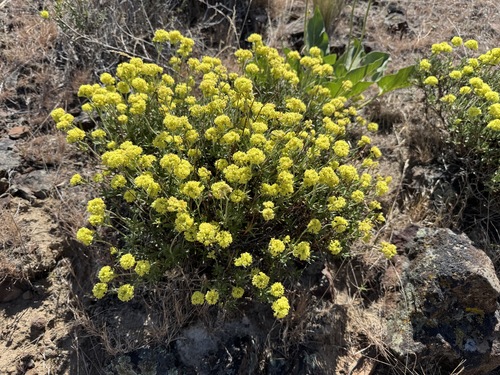


Rock Buckwheat
eriogonum sphaerocephalum
Rock Buckwheat (Eriogonum sphaerocephalum), also known as round-headed buckwheat, is a hardy perennial subshrub native to the arid landscapes of western North America. Thriving in some of the most unforgiving environments, including volcanic slopes, basalt cliffs, and sagebrush steppes, this resilient plant serves as a vital ecological anchor. It forms low, sprawling mats of woody stems that stabilize loose, rocky soils and prevent erosion in wind-swept basins. During the late spring and summer months, Rock Buckwheat transforms dry, dusty hillsides with its abundant, globe-like clusters of warm yellow flowers. These blossoms provide crucial nectar and pollen for a diverse array of native bees, butterflies, and other beneficial insects. Its adaptability to poor soils and extreme temperatures makes it a fascinating model of survival in rain-shadow deserts.
Lebensraum: Found in dry, rocky soils, sagebrush steppes, basalt outcrops, and volcanic slopes throughout the intermountain West.
This low-growing subshrub typically forms a dense, rounded mound or mat reaching 10 to 40 centimeters in height. Its small, spoon-shaped to linear leaves are dark green on top and coated with a dense layer of white, woolly hairs underneath, giving the foliage a silvery-green appearance. The most defining feature is the spherical flower cluster, measuring 1 to 3 centimeters across, borne on erect stems. These flowers range in color from a bright, buttery yellow to a deep ochre or cream, often aging to a warm reddish-orange hue.
Kategorie
PflanzenSeltenheit
Common
Gefahr
1/5 · Sehr gering
Snaps
Mach den ersten Snap!
Because it thrives in nutrient-poor volcanic soils, it is often one of the first pioneer plants to colonize hardened lava flows and ash fields.
Indigenous peoples of the Great Basin and Columbia Plateau traditionally used infusions of this plant's roots and leaves to treat colds and tuberculosis.
The species name 'sphaerocephalum' translates to 'spherical-headed,' a direct reference to its distinct, ball-shaped flower clusters.
The dense layer of tiny white hairs (tomentum) on its leaves reflects intense solar radiation and traps a boundary layer of moisture, drastically reducing water loss from evaporation.
It develops a rugged, deep-reaching taproot system that penetrates narrow cracks in basalt and rocky substrate to secure water and hold the plant firm against strong winds.
A tough, woody base allows the plant to survive wildfire, harsh winter freezes, and grazing by resprouting from its durable crown.
As a photoautotrophic plant, Rock Buckwheat produces its own energy through photosynthesis, converting sunlight, carbon dioxide, and water into sugars.
Callophrys sheridanii
Serves as a vital host plant for the caterpillars of this small, beautiful green butterfly.
Odocoileus hemionus
Forages on the plant's leaves and seed heads during the sparse winter and dry summer months.
Apis mellifera
Visits the vibrant yellow flowers to collect nectar, acting as one of its primary insect pollinators.
Für dieses Objekt sind noch keine Merkmal-Badges vergeben.
Noch keine Alternativnamen vorhanden.
Sammlungen für dieses Objekt erscheinen hier, wenn weitere Themen hinzugefügt werden.
Gefahr
1/5 · Sehr gering
Noch keine besonderen Sicherheitshinweise.
Der einfachste Weg, Rock Buckwheat zu bestimmen, ist die Verwendung der Naturführer-App Snappit.
10-40 cm
5-20 Jahre
As a photoautotrophic plant, Rock Buckwheat produces its own energy through photosynthesis, converting sunlight, carbon dioxide, and water into sugars.
Found in dry, rocky soils, sagebrush steppes, basalt outcrops, and volcanic slopes throughout the intermountain West.
Zoome hinein, um Cluster aufzulösen und zu sehen, wo dieses Objekt fotografiert wurde.
Neueste Snaps erscheinen hier, wenn neue Beobachtungen hinzukommen.












