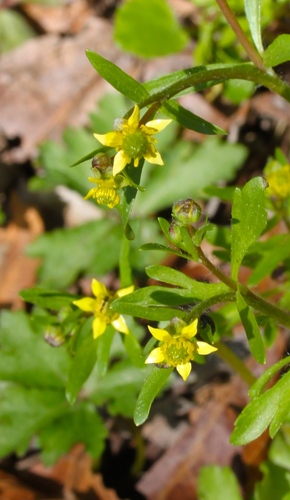


Rock Buttercup
ranunculus micranthus
The Rock Buttercup, Ranunculus micranthus, is a delicate yet resilient wildflower native to rocky and open wooded areas across eastern and central North America. Despite its small stature, this species contributes significantly to early spring ecosystems, often being one of the first wildflowers to emerge and bloom. Its presence signals the awakening of the forest floor, providing early season nectar for pollinators and adding a splash of subtle yellow to the emerging greenery. Adaptable to relatively harsh, dry conditions, it thrives where many other plants might struggle, embodying the tenacity of nature in often overlooked niches.
Lebensraum: Found in dry to mesic open woodlands, rocky slopes, bluffs, and glades, often on calcareous soils.
This small plant typically grows 10-30 cm tall, featuring finely divided basal leaves that are somewhat hairy. The stems are slender and often branched, bearing small, pale yellow flowers, usually with 5 petals that are notably shorter than the sepals, giving the bloom a cup-like appearance. The petals are often an inch or less in diameter, and the center is packed with numerous stamens. The leaves along the stem are alternately arranged and progressively smaller.
Kategorie
PflanzenSeltenheit
Common
Gefahr
1/5 · Sehr gering
Snaps
Mach den ersten Snap!
Its ability to thrive in poor, rocky soils makes it an important component of glade and bluff ecosystems, helping to stabilize soil and support early spring insect life.
Like other members of the Ranunculus genus, the Rock Buttercup contains ranunculin, a toxic glycoside that can be converted into protoanemonin when the plant tissue is damaged, making it unpalatable to most herbivores.
The genus name Ranunculus comes from the Latin word "rana" meaning "little frog," as many species of buttercups grow near water, though the Rock Buttercup prefers drier, rocky habitats.
Unlike many showy garden flowers, the Rock Buttercup's petals are often shorter than its sepals, giving its small yellow blooms a distinct, understated appearance.
The Rock Buttercup is well-adapted to drier conditions, often growing in rocky soils or exposed areas where moisture can be scarce. Its root system helps it access and retain water efficiently.
This species typically flowers in early spring, taking advantage of sunlight that reaches the forest floor before the tree canopy fully leafs out. This early bloom provides crucial resources for emergent pollinators.
After flowering, the plant produces an aggregate of achenes, which are small, dry, single-seeded fruits. These seeds are dispersed by wind or small animals, aiding its spread in its preferred rocky habitats.
As a photosynthetic plant, the Rock Buttercup produces its own food by converting sunlight, carbon dioxide, and water into sugars, drawing essential minerals from the soil.
Ceratina calcarata
Pollinator for early spring.
Odocoileus virginianus
Herbivore grazing on foliage.
Puccinia ranunculi
Potential host for a fungal pathogen.
Für dieses Objekt sind noch keine Merkmal-Badges vergeben.
Noch keine Alternativnamen vorhanden.
Sammlungen für dieses Objekt erscheinen hier, wenn weitere Themen hinzugefügt werden.
Gefahr
1/5 · Sehr gering
Noch keine besonderen Sicherheitshinweise.
Der einfachste Weg, Rock Buttercup zu bestimmen, ist die Verwendung der Naturführer-App Snappit.
10-30 cm
0.001-0.01 kg
1-3 Jahre
As a photosynthetic plant, the Rock Buttercup produces its own food by converting sunlight, carbon dioxide, and water into sugars, drawing essential minerals from the soil.
Found in dry to mesic open woodlands, rocky slopes, bluffs, and glades, often on calcareous soils.
Photosynthesis And Nutrient Absorption
50-200
Zoome hinein, um Cluster aufzulösen und zu sehen, wo dieses Objekt fotografiert wurde.
Neueste Snaps erscheinen hier, wenn neue Beobachtungen hinzukommen.








