

Rosette Grasses
dichanthelium
Rosette Grasses (genus Dichanthelium) are an intriguing group of perennial grasses widely distributed across North America. They are famous for their unique dimorphic growth cycle, which consists of two distinct phases: in the spring, they produce tall, upright flowering stems, while in the autumn, they transition to a low-growing, basal rosette of leaves. This clever evolutionary strategy helps them survive harsh winter conditions and kickstart photosynthesis early the following spring before taller plants shade them out. They play a crucial ecological role by stabilizing soils, particularly in sandy areas, and providing food and shelter for a variety of insects, birds, and small mammals.
Lebensraum: Typically found in sandy soils, open woodlands, pine barrens, savannahs, and disturbed fields across North America.
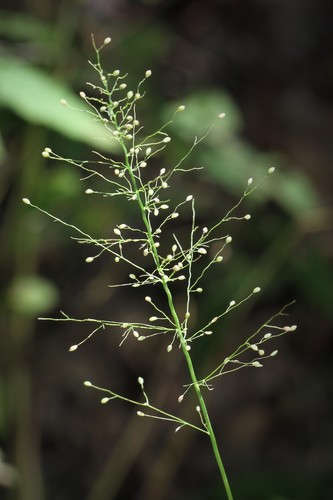
Rosette grasses are small, clump-forming perennial grasses that change form seasonally. In spring and summer, they feature erect, often hairy stems reaching 15 to 100 cm in height, topped with open, airy flower clusters (panicles) of small, egg-shaped green or purplish spikelets. During autumn and winter, the tall stems wither and are replaced by a flat, ground-hugging rosette of short, wide, lance-shaped leaves that remain green through the cold months.
Kategorie
PflanzenSeltenheit
Common
Gefahr
1/5 · Sehr gering
Snaps
Mach den ersten Snap!
The scientific genus name Dichanthelium translates to 'double-blooming', highlighting its unusual dual spring and autumn flowering cycles.
The tiny hairs on the stems and leaves of many rosette grass species act as a physical defense to deter crawling insect herbivores.
Their green winter rosettes provide an essential winter food source for forest herbivores like rabbits and white-tailed deer when other forage is scarce.
They produce two highly distinct growth forms per year, utilizing tall stems in spring and flat, ground-hugging rosettes in winter to maximize survival and light absorption.
They produce closed, self-pollinating flowers late in the season within their leaf sheaths, ensuring reproduction even during stressful conditions.
Many species possess tough, underground rhizomes that allow them to quickly regenerate after wildfires or prolonged drought.
As photoautotrophic plants, rosette grasses produce their own energy by utilizing sunlight, carbon dioxide, water, and soil minerals through the process of photosynthesis.
Anatrytone logan
Serves as a primary larval host plant for the caterpillars of this skipper butterfly.
Meleagris gallopavo
Feeds extensively on the fallen seeds (caryopses) of rosette grasses during the autumn and winter months.
Glomus intraradices
Forms a symbiotic root association that improves water and phosphorus uptake in nutrient-poor sandy soils.
Für dieses Objekt sind noch keine Merkmal-Badges vergeben.
Noch keine Alternativnamen vorhanden.
Sammlungen für dieses Objekt erscheinen hier, wenn weitere Themen hinzugefügt werden.
Gefahr
1/5 · Sehr gering
Noch keine besonderen Sicherheitshinweise.
Der einfachste Weg, Rosette Grasses zu bestimmen, ist die Verwendung der Naturführer-App Snappit.
15-100 cm
2-10 Jahre
As photoautotrophic plants, rosette grasses produce their own energy by utilizing sunlight, carbon dioxide, water, and soil minerals through the process of photosynthesis.
Typically found in sandy soils, open woodlands, pine barrens, savannahs, and disturbed fields across North America.
Zoome hinein, um Cluster aufzulösen und zu sehen, wo dieses Objekt fotografiert wurde.
Neueste Snaps erscheinen hier, wenn neue Beobachtungen hinzukommen.