

Round-Leaved St John'S-Wort
hypericum nummularium
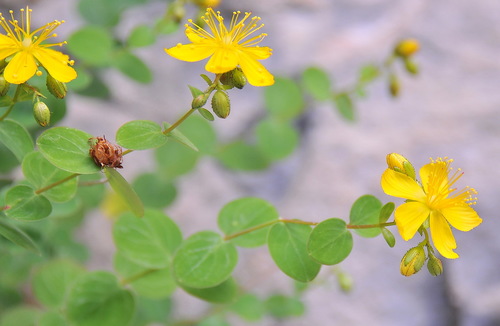
The Round-Leaved St John's-Wort is a charming perennial wildflower native to the rocky, limestone-rich slopes of southwestern Europe, particularly the Pyrenees and the western Alps. Unlike its upright, tall cousins, this species boasts a low-growing, prostrate habit. It drapes itself gracefully over sheer rock faces and crevices, forming cushions of rounded, bluish-green foliage that resemble tiny coins scattered across the stone. During the summer, these mountain gems come alive with bright yellow flowers, adding a splash of vibrant color to the stark alpine landscape.
Lebensraum: Found in damp limestone rock crevices, mountain scree slopes, and shaded alpine cliffs.
This creeping perennial typically reaches heights of only 5 to 20 cm, spreading horizontally over rocky surfaces. Its small, opposite, almost perfectly circular leaves are glaucous or bluish-green, with tiny translucent glands visible under close inspection. The star-like flowers are bright golden-yellow, measuring 1.5 to 2.5 cm across, with five distinct petals that may show tiny black dots along the margins. The center of each flower is crowded with a dense, brush-like cluster of numerous long, protruding stamens.
Kategorie
PflanzenSeltenheit
Common
Gefahr
1/5 · Sehr gering
Snaps
Mach den ersten Snap!
It is a specialist of karst landscapes, perfectly adapted to survive in areas with soluble rocks where surface water quickly disappears underground.
The species name 'nummularium' is derived from the Latin word for coin ('nummulus'), referencing the beautifully round, coin-like shape of its leaves.
Unlike common St John's-wort, which grows tall and weed-like, this species behaves like a delicate mountain groundcover.
It possesses highly specialized, deep-reaching root systems that can wedge into tight limestone fissures to secure moisture and anchoring.
Its creeping, low-lying growth pattern helps it survive freezing alpine temperatures and high-velocity mountain winds.
The foliage contains hypericin and other secondary metabolites that act as natural deterrents against insects and mammalian grazers.
As a photosynthetic plant, it produces its own energy using sunlight, carbon dioxide, and water while absorbing essential minerals from limestone soils.
Bombus monticola
Visits the bright yellow blossoms for nectar and pollen, acting as an alpine pollinator.
Rupicapra pyrenaica
Feeds occasionally on the subalpine vegetation of the Pyrenees, including wild St John's-worts.
Campanula cochleariifolia
Competes for precious space and moisture in narrow rock fissures on alpine cliffs.
Für dieses Objekt sind noch keine Merkmal-Badges vergeben.
Noch keine Alternativnamen vorhanden.
Sammlungen für dieses Objekt erscheinen hier, wenn weitere Themen hinzugefügt werden.
Gefahr
1/5 · Sehr gering
Noch keine besonderen Sicherheitshinweise.
Der einfachste Weg, Round-Leaved St John'S-Wort zu bestimmen, ist die Verwendung der Naturführer-App Snappit.
5-20 cm
3-10 Jahre
As a photosynthetic plant, it produces its own energy using sunlight, carbon dioxide, and water while absorbing essential minerals from limestone soils.
Found in damp limestone rock crevices, mountain scree slopes, and shaded alpine cliffs.
Zoome hinein, um Cluster aufzulösen und zu sehen, wo dieses Objekt fotografiert wurde.
Neueste Snaps erscheinen hier, wenn neue Beobachtungen hinzukommen.
















.jpg&width=800)

