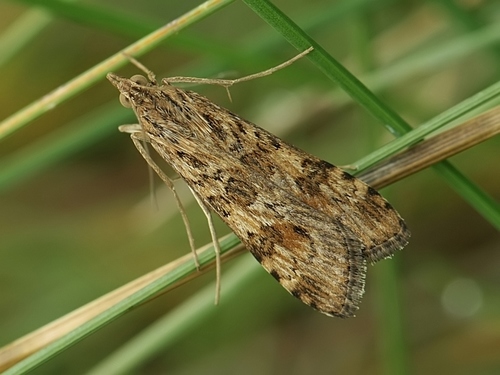


Rush Veneer
nomophila noctuella
The Rush Veneer (Nomophila noctuella) is a remarkable, highly migratory moth belonging to the grass moth family, Crambidae. Despite its unassuming, slender appearance, this insect is renowned for its incredible long-distance flights, often traveling thousands of kilometers from North Africa and Southern Europe to Northern Europe and Central Asia. It is frequently observed in open grassy habitats, where it can be flushed from the vegetation during the day, taking off in a sudden, rapid zig-zag flight before settling down again just a few meters away. This moth acts as an important pollinator for various wildflowers and serves as a vital food source for nocturnal predators. Its adaptability and broad range of larval host plants allow it to thrive in diverse environments, from coastal dunes and meadows to urban gardens.
Lebensraum: Found in a wide variety of open habitats, including grassy meadows, coastal sand dunes, pastures, agricultural fields, and urban gardens.
The Rush Veneer is characterized by its exceptionally long, narrow forewings, which are pale greyish-brown to yellowish-brown, adorned with distinct dark brown spots including two prominent, kidney-shaped markings. When resting, it wraps its wings tightly around its body, creating a cylindrical, stick-like profile. The hindwings are much broader, semi-translucent, and a pale smoky-grey color, visible only when the moth is in flight. It has a wingspan of approximately 2 to 3 cm and long, slender legs that help it perch delicately on grass stems.
Kategorie
InsektenSeltenheit
Common
Gefahr
1/5 · Sehr gering
Snaps
Mach den ersten Snap!
Despite being only a few centimeters wide, the Rush Veneer can cross the English Channel and fly over the Alps during its seasonal migrations.
Its scientific name, 'noctuella', refers to its resemblance to certain noctuid moths, even though it actually belongs to the crambid snout moth family.
The caterpillars live in silken webs or tubes spun near the base of their host plants, protecting them from dry conditions and predators.
Capable of riding high-altitude wind currents to migrate thousands of kilometers across continents from wintering grounds to northern territories.
Folds its wings tightly around its body when resting on reeds or grass stems, mimicking a dry leaf sheath or twig to avoid predators.
When disturbed during the day, it flies in an erratic, low-altitude zig-zag pattern before quickly diving back into the safety of the undergrowth.
Larvae feed on the leaves of various low-growing herbaceous plants and grasses, while the adult moths feed on nectar from wildflowers.
Altersunterschiede: Larvae are leaf-chewers consuming herbaceous foliage, whereas adults have a proboscis and feed exclusively on liquid nectar.
Trifolium pratense
The caterpillars feed on the leaves and stems of this common clover species.
Pipistrellus pipistrellus
Nocturnal adults are preyed upon by foraging bats using echolocation.
Erithacus rubecula
Larvae are a frequent food source for ground-dwelling insectivorous birds during the breeding season.
Für dieses Objekt sind noch keine Merkmal-Badges vergeben.
Noch keine Alternativnamen vorhanden.
Sammlungen für dieses Objekt erscheinen hier, wenn weitere Themen hinzugefügt werden.
Gefahr
1/5 · Sehr gering
Noch keine besonderen Sicherheitshinweise.
Der einfachste Weg, Rush Veneer zu bestimmen, ist die Verwendung der Naturführer-App Snappit.
1+ cm
2+ cm
0.0001+ kg
0+ Jahre
15 km/h
Larvae feed on the leaves of various low-growing herbaceous plants and grasses, while the adult moths feed on nectar from wildflowers.
Found in a wide variety of open habitats, including grassy meadows, coastal sand dunes, pastures, agricultural fields, and urban gardens.
Zoome hinein, um Cluster aufzulösen und zu sehen, wo dieses Objekt fotografiert wurde.
Neueste Snaps erscheinen hier, wenn neue Beobachtungen hinzukommen.



.jpg&width=800)