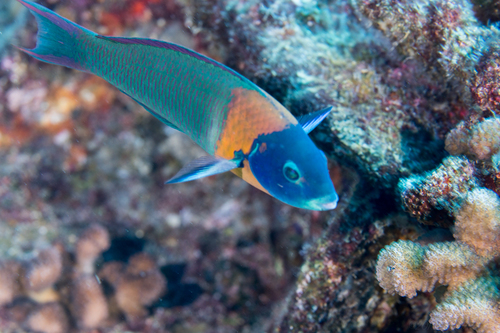


Saddle Wrasse
thalassoma duperrey
The Saddle Wrasse (Thalassoma duperrey), known locally in Hawaii as hinalealauwili, is one of the most common and curious reef fish found in the Hawaiian archipelago. Extremely abundant in shallow coastal waters, these active, diurnal swimmers are famous for their bold, inquisitive nature. They often follow divers and snorkelers, hoping the disturbance will kick up tasty invertebrates from the sandy bottom or reef crevices. As protogynous hermaphrodites, their life history is a fascinating journey of transformation, transitioning from female to male when social structures demand. Their ubiquitous presence and playful behavior make them an absolute favorite for marine life observers in Hawaiian waters.
Lebensraum: Found in shallow coral reefs, rocky shorelines, and sandy-bottomed lagoons throughout the Hawaiian Islands.
Easily recognized by their vibrant, multicolored bodies, adult Saddle Wrasses feature a deep blue-green head, a prominent bright orange-red vertical band (or 'saddle') just behind the gill covers, and a greenish-blue body. Their tail fin is lyre-shaped, particularly in terminal phase males. Juveniles look strikingly different, displaying a horizontal dark stripe along a pale body, which helps them blend in. They grow to a maximum length of about 25 centimeters.
Kategorie
FischeSeltenheit
Common
Gefahr
1/5 · Sehr gering
Snaps
Mach den ersten Snap!
If the dominant male in a social group dies, the largest female will begin changing color and behavior to take his place within hours, fully transitioning into a fertile male in a matter of weeks.
The Hawaiian name for this fish is hinalealauwili, which refers to its erratic, twisting swimming pattern around the reef.
They are so bold and inquisitive that snorkelers often find themselves surrounded by them just by gently kicking sand with their fins.
They begin life as females and can transition into colorful terminal males when the dominant male of a harem dies.
They actively follow larger marine animals or human divers to feed on small organisms exposed by disturbed substrate.
They use their pectoral fins in a wing-like flapping motion to maneuver agilely around complex coral structures.
They are opportunistic carnivores that feed primarily on a wide variety of small benthic invertebrates found on the reef and in the sand.
Altersunterschiede: Juveniles often act as cleaner fish, picking parasites off larger fish, whereas adults feed strictly on benthic invertebrates.
Triaenodon obesus
Preys upon this small wrasse as a regular part of its reef diet.
Paracirrhites arcatus
Competes directly for food resources, hunting for small invertebrates in the same reef crevices.
Gymnothorax javanicus
Juvenile wrasses clean parasites off the body and gills of this large eel.
Für dieses Objekt sind noch keine Merkmal-Badges vergeben.
Noch keine Alternativnamen vorhanden.
Sammlungen für dieses Objekt erscheinen hier, wenn weitere Themen hinzugefügt werden.
Gefahr
1/5 · Sehr gering
Noch keine besonderen Sicherheitshinweise.
Der einfachste Weg, Saddle Wrasse zu bestimmen, ist die Verwendung der Naturführer-App Snappit.
10-25 cm
0.1-0.3 kg
3-7 Jahre
15 km/h
They are opportunistic carnivores that feed primarily on a wide variety of small benthic invertebrates found on the reef and in the sand.
Found in shallow coral reefs, rocky shorelines, and sandy-bottomed lagoons throughout the Hawaiian Islands.
Foraging
Zoome hinein, um Cluster aufzulösen und zu sehen, wo dieses Objekt fotografiert wurde.
Neueste Snaps erscheinen hier, wenn neue Beobachtungen hinzukommen.












