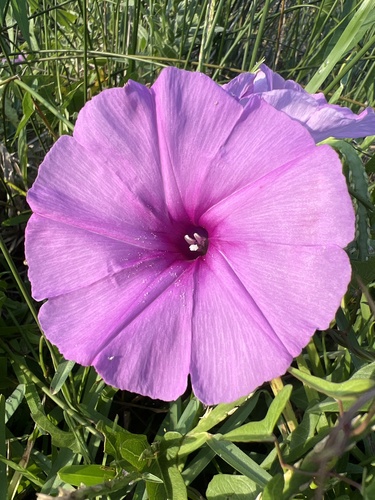


Saltmarsh Morning-Glory
ipomoea sagittata
The Saltmarsh Morning-Glory (Ipomoea sagittata) is a resilient and vigorous perennial vine native to the coastal wetlands of the southeastern United States, the Caribbean, and parts of Mexico. Renowned for its ability to thrive in highly saline environments where few other flowering plants can survive, this hardy species plays a vital role in stabilizing fragile coastal soils. It climbs over marsh grasses and low shrubs to reach sunlight, providing a gorgeous burst of color against the green and brown tones of brackish marshes. Its large, trumpet-shaped flowers open early in the morning, attracting various native bees and other pollinators during the peak of summer.
Lebensraum: Typically found in coastal salt marshes, brackish wetlands, and sandy maritime dunes along coastlines.
This twining vine is easily distinguished by its arrowhead-shaped (sagittate) leaves, which feature prominent backward-pointing lobes and taper to a sharp tip. The striking funnel-shaped flowers range from bright pink to rich lavender-purple, typically with a contrasting dark magenta throat, and measure 5 to 8 centimeters in diameter. The stems are slender, hairless, and green to purplish-red, lacks tendrils, and instead climb by wrapping their entire bodies tightly around neighboring vegetation.
Kategorie
PflanzenSeltenheit
Common
Gefahr
1/5 · Sehr gering
Snaps
Mach den ersten Snap!
Each individual flower blooms for only a single day, unraveling at sunrise and withering into a purple mass by afternoon.
The species name 'sagittata' is Latin for 'arrow-shaped', highlighting the plant's distinctive pointed leaves.
Unlike many garden morning-glories, this species has evolved roots that can withstand frequent submergence in salty water.
Features specialized physiological mechanisms that exclude salt at the root level and manage internal salinity, allowing it to thrive in saline coastal soils.
Exhibits highly sensitive touch-responsive climbing, wrapping its slender stems securely around marsh grasses to hoist itself into sunlight.
Opens its high-contrast, nectar-rich blooms rapidly at dawn and closes them by afternoon to maximize pollination efficiency when native bees are most active.
As a photosynthetic plant, it manufactures its own sugars using sunlight, water, carbon dioxide, and nutrients absorbed from saltmarsh soils.
Bombus impatiens
The flowers are visited and pollinated by bumblebees seeking morning nectar.
Agrius cingulata
The foliage serves as a host plant for the caterpillars of the sweetpotato hornworm moth.
Für dieses Objekt sind noch keine Merkmal-Badges vergeben.
Noch keine Alternativnamen vorhanden.
Sammlungen für dieses Objekt erscheinen hier, wenn weitere Themen hinzugefügt werden.
Gefahr
1/5 · Sehr gering
Noch keine besonderen Sicherheitshinweise.
Der einfachste Weg, Saltmarsh Morning-Glory zu bestimmen, ist die Verwendung der Naturführer-App Snappit.
100-400 cm
3-10 Jahre
As a photosynthetic plant, it manufactures its own sugars using sunlight, water, carbon dioxide, and nutrients absorbed from saltmarsh soils.
Typically found in coastal salt marshes, brackish wetlands, and sandy maritime dunes along coastlines.
Foraging
1-4
10-21 Tage
Zoome hinein, um Cluster aufzulösen und zu sehen, wo dieses Objekt fotografiert wurde.
Neueste Snaps erscheinen hier, wenn neue Beobachtungen hinzukommen.