

Sand Blazingstar
mentzelia involucrata
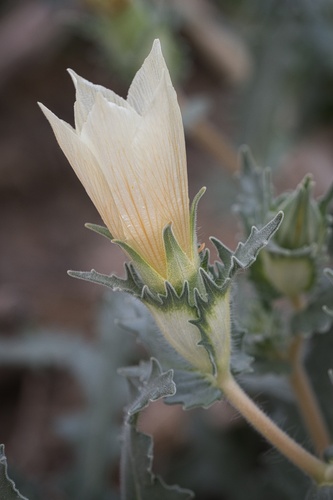
The Sand Blazingstar (Mentzelia involucrata) is a striking annual wildflower native to the harsh desert environments of the southwestern United States and northwestern Mexico. Rising from the arid soils of the Mojave and Sonoran deserts, this resilient plant captivates hikers and botanists alike with its large, luminous flowers that seem to glow against the stark desert backdrop. It is particularly noted for the large, papery, white-to-pale-green bracts that cradle the base of each blossom, acting like protective collars. Perfectly adapted to life in sand dunes, gravelly washes, and rocky canyon slopes, the Sand Blazingstar plays an important ecological role. It bursts into life following winter rains, painting the desert floor with delicate shades of cream and silver. Its sticky, Velcro-like leaves and stems are a classic hallmark of the Loasaceae family, helping it deter unwanted climbing herbivores while conserving precious moisture.
Lebensraum: Found in dry, sandy desert washes, gravelly slopes, and canyon floors within arid creosote scrub environments.
This plant typically grows as a branching annual up to 30 or 40 centimeters tall, featuring pale, nearly white stems that are covered in fine, barbed hairs. Its leaves are lance-shaped with wavy, coarsely-toothed margins, and they feel rough and sticky to the touch. The defining visual feature is the stunning, cup-shaped flower, which spans 3 to 5 centimeters across with five pale-yellow to cream-colored petals that often exhibit delicate pink or orange veining. These flowers are nested within large, highly conspicuous, silver-white bracts with dark green margins and prominent veins, giving the entire inflorescence a luminous, multi-layered appearance.
Kategorie
PflanzenSeltenheit
Common
Gefahr
1/5 · Sehr gering
Snaps
Mach den ersten Snap!
Its seeds can lie dormant in dry desert soil for years, waiting for the perfect sequence of winter rains before finally germinating.
The bright, reflective white bracts beneath the flower act like tiny satellite dishes, concentrating sunlight and warmth to attract chilly desert bees.
The common family name 'stickleaf' is no joke; the leaves are covered in tiny hooked hairs that stick to clothing like organic Velcro.
The stems and leaves are covered in microscopic, barbed hairs that cause the plant to stick tightly to fur and clothing, helping to deter herbivorous pests.
Large, silvery-white bracts surrounding the flowers reflect light, making the plant highly visible to nocturnal and crepuscular desert pollinators.
Seeds can remain dormant in dry desert soils for several years, germinating rapidly only when winter rainfall is sufficient.
As a photoautotrophic plant, the Sand Blazingstar produces its own energy through photosynthesis, utilizing sunlight, carbon dioxide, and water.
Lasioglossum
Pollinates the flowers while gathering nectar and pollen.
Ovis canadensis nelsoni
Feeds on the annual spring vegetation, including flowers and leaves of the blazingstar.
Larrea tridentata
Grows in the same desert scrub community, competing for limited water and soil nutrients.
Für dieses Objekt sind noch keine Merkmal-Badges vergeben.
Noch keine Alternativnamen vorhanden.
Sammlungen für dieses Objekt erscheinen hier, wenn weitere Themen hinzugefügt werden.
Gefahr
1/5 · Sehr gering
Noch keine besonderen Sicherheitshinweise.
Der einfachste Weg, Sand Blazingstar zu bestimmen, ist die Verwendung der Naturführer-App Snappit.
10-40 cm
As a photoautotrophic plant, the Sand Blazingstar produces its own energy through photosynthesis, utilizing sunlight, carbon dioxide, and water.
Found in dry, sandy desert washes, gravelly slopes, and canyon floors within arid creosote scrub environments.
Zoome hinein, um Cluster aufzulösen und zu sehen, wo dieses Objekt fotografiert wurde.
Neueste Snaps erscheinen hier, wenn neue Beobachtungen hinzukommen.












