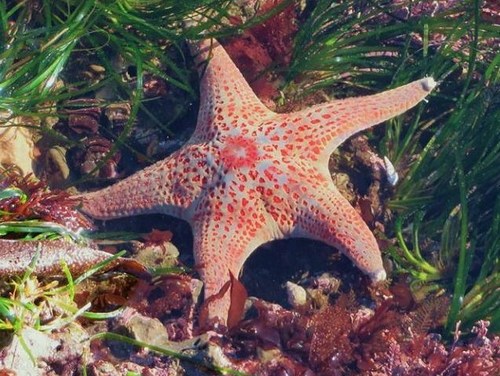
Sand Star
luidia foliolata
The Sand Star is a fascinating sea creature that looks like a star! It has many arms that help it move across the ocean floor.
Lebensraum: Shallow coastal waters and sandy ocean floors.
The Sand Star is a very flat sea star, typically with five long, leaf-like arms. Its body is light tan to grey-green, often speckled, allowing it to blend perfectly with sandy seabeds.
Kategorie
InvertebrateSeltenheit
Common
Gefahr
1/5 · Sehr gering
Snaps
Mach den ersten Snap!
Sand Stars belong to a group called "echinoderms," meaning "spiny skin."
Some Sand Star species can move surprisingly fast for a sea star!
Their mouth is located on their underside, facing directly into the sand.
They move across the seabed using thousands of tiny, suction-cup-like tube feet!
Sand Stars can regrow lost arms because of their special regenerative cells, which helps them survive predator attacks.
Sand Stars can rapidly bury themselves just beneath the sand because of their pointed tube feet, which helps them hide from predators.
Sand Stars can push their stomach outside their body to digest prey externally, which helps them eat larger food items.
Tiny crustaceans and worms are a favorite meal for this sandy hunter.
Enhydra lutris
Otters can crush and eat sea stars.

Metacarcinus magister
Crabs prey on smaller or injured sea stars.
Nereis vexillosa
Actively consumes marine worms living in the sand.
Einzelgänger leben den größten Teil ihres Lebens allein und interagieren mit Artgenossen nur zur Paarung oder zur Aufzucht der Jungen.
Farbenfroh beschreibt Organismen oder Objekte, die eine große Vielfalt an leuchtenden und deutlich erkennbaren Farben aufweisen.
Getarnt beschreibt Organismen, die über eine Färbung oder Musterung verfügen, durch die sie mit ihrer Umgebung verschmelzen.
Dieses Merkmal kennzeichnet Organismen, deren Ernährung vollständig oder hauptsächlich aus tierischem Gewebe besteht.

Marine Lebensräume umfassen alle Salzwasserumgebungen der Ozeane der Erde und beherbergen eine immense Vielfalt an Wasserlebewesen.
Gefahr
1/5 · Sehr gering
Noch keine besonderen Sicherheitshinweise.
35 cm
0.2 kg
12 Jahre
Tiny crustaceans and worms are a favorite meal for this sandy hunter.
Shallow coastal waters and sandy ocean floors.
Foraging
Zoome hinein, um Cluster aufzulösen und zu sehen, wo dieses Objekt fotografiert wurde.
Neueste Snaps erscheinen hier, wenn neue Beobachtungen hinzukommen.