

Savannah Meadowbeauty
rhexia alifanus
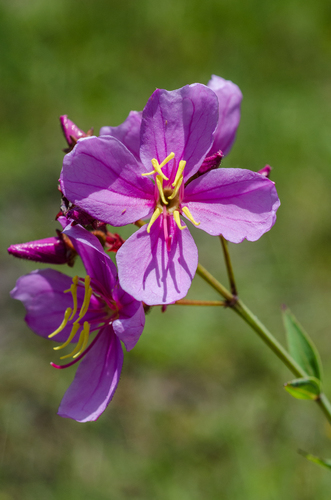
The Savannah Meadowbeauty (Rhexia alifanus) is a striking, tall perennial wildflower native to the damp pine savannas and bogs of the southeastern United States. Standing out as the largest and most robust member of the meadowbeauty genus, this plant is celebrated for its showy, bright magenta to lavender blossoms that decorate coastal plains throughout the summer. It serves as an ecological anchor in its native wet-savanna communities, relying on high light levels and wet, acidic soils to flourish. This resilient wildflower has a fascinating relationship with native bumblebees, requiring specialized buzz pollination to successfully release its pollen. Its presence is often an indicator of a healthy, fire-maintained wetland ecosystem, as it struggles to survive in shaded or overgrown habitats.
Lebensraum: Found in wet pine savannas, acidic bogs, flatwoods, and coastal plain seepage slopes.
This herbaceous perennial grows tall and erect, reaching heights of 60 to 120 cm on smooth, reddish-green square stems. It features lance-shaped, sessile leaves arranged oppositely, with distinct parallel veins characteristic of the family Melastomataceae. The prominent, four-petaled flowers are large and showy, spanning 4 to 5 cm across in shades of rich pink, lavender, or magenta. A defining feature is the central cluster of bright yellow, strongly curved, sickle-shaped stamens that contrast vividly with the colorful petals.
Kategorie
PflanzenSeltenheit
Common
Gefahr
1/5 · Sehr gering
Snaps
Mach den ersten Snap!
It is the tallest species in the genus Rhexia, sometimes reaching over four feet in height.
Its striking yellow stamens look like tiny curved sickles, which is a classic visual identifier for this group of plants.
Without regular wildfires to clear out woody brush and trees, this sun-loving plant will quickly decline and disappear from its habitat.
Features poricidal anthers that only release pollen when vibrated at specific frequencies by the flight muscles of visiting bumblebees.
Possesses a specialized underground root system that allows it to quickly resprout and bloom vigorously after periodic wildfires.
Thrives in highly acidic, nutrient-deficient, and saturated soils where other competing plant species struggle to survive.
As a photosynthetic plant, the Savannah Meadowbeauty synthesizes its own food using sunlight, water, and carbon dioxide, while absorbing minerals from wet, acidic soils.
Bombus pensylvanicus
Relies on bumblebees for pollination via specialized buzz pollination techniques.
Odocoileus virginianus
White-tailed deer occasionally graze on the foliage and young shoots of the plant.
Für dieses Objekt sind noch keine Merkmal-Badges vergeben.
Noch keine Alternativnamen vorhanden.
Sammlungen für dieses Objekt erscheinen hier, wenn weitere Themen hinzugefügt werden.
Gefahr
1/5 · Sehr gering
Noch keine besonderen Sicherheitshinweise.
Der einfachste Weg, Savannah Meadowbeauty zu bestimmen, ist die Verwendung der Naturführer-App Snappit.
60-120 cm
3-8 Jahre
As a photosynthetic plant, the Savannah Meadowbeauty synthesizes its own food using sunlight, water, and carbon dioxide, while absorbing minerals from wet, acidic soils.
Found in wet pine savannas, acidic bogs, flatwoods, and coastal plain seepage slopes.
Zoome hinein, um Cluster aufzulösen und zu sehen, wo dieses Objekt fotografiert wurde.
Neueste Snaps erscheinen hier, wenn neue Beobachtungen hinzukommen.









.jpg&width=800)