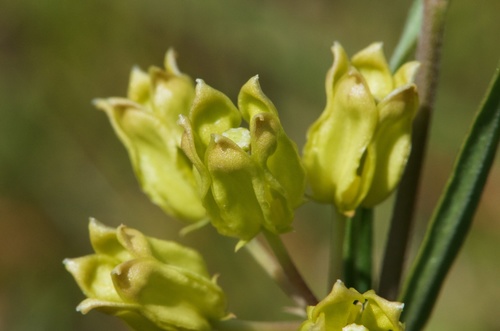


Savannah Milkweed
asclepias pedicellata
Savannah Milkweed (Asclepias pedicellata) is a charming and slender perennial wildflower native to the coastal plain savannas and wet pine flatwoods of the southeastern United States. Standing quietly among wiregrasses, this species is uniquely adapted to thrive in nutrient-poor, fire-prone ecosystems. Unlike its more robust and showy cousins, Savannah Milkweed sports a delicate, unassuming stature that can make it a thrilling find for botanists and nature enthusiasts. It plays an essential role in its local ecosystem, acting as a crucial food source for specialized insects while tolerating the damp, sandy soils of its native habitat. Its survival is deeply intertwined with the natural fire regimes of the longleaf pine ecosystem, where periodic blazes clear competing underbrush and allow this resilient little plant to flourish.
Lebensraum: Typically found in wet pine flatwoods, longleaf pine savannas, pitcher plant bogs, and damp grassy roadsides of the southeastern coastal plain.
This small perennial herb grows from 10 to 45 cm tall, featuring slender, erect, and mostly unbranched stems. Its narrow, linear leaves are arranged oppositely along the stem and measure up to 10 cm in length. The most distinctive feature of the Savannah Milkweed is its cluster of greenish-yellow to cream-colored flowers. Unlike other milkweeds, these flowers have notably long stalks (pedicels) and completely lack horns inside their hoods, giving them a distinct, simplified crown appearance that blends seamlessly with the surrounding savanna grasses.
Kategorie
PflanzenSeltenheit
Common
Gefahr
1/5 · Sehr gering
Snaps
Mach den ersten Snap!
It is highly dependent on periodic wildfires; without fire to clear competing understory plants, populations quickly decline.
The scientific name pedicellata is derived from the exceptionally long flower stalks, or pedicels, which distinguish it from other milkweeds.
Unlike almost all other North American milkweeds, the flowers of Savannah Milkweed do not have any horn structures inside their hoods.
Synthesizes toxic cardiac glycosides within its tissues to deter generalist herbivores from feeding on its leaves.
Features a deep, starch-rich taproot that allows the plant to easily resprout and bloom immediately after low-intensity wildfires.
Possesses uniquely simplified flowers without hoods' horns, optimizing pollination by specific local insects like wasps and bees.
As a photoautotrophic plant, it produces its own energy using sunlight, water, carbon dioxide, and essential soil nutrients.
Danaus plexippus
Larvae feed exclusively on the leaves, absorbing toxic cardenolides for their own defense.
Bombus pennsylvanicus
Adults visit the long-pedicelled flowers to feed on rich nectar and assist in pollination.
Danaus gilippus
Caterpillars feed on the foliage to gain toxicity against avian predators.
Für dieses Objekt sind noch keine Merkmal-Badges vergeben.
Noch keine Alternativnamen vorhanden.
Sammlungen für dieses Objekt erscheinen hier, wenn weitere Themen hinzugefügt werden.
Gefahr
1/5 · Sehr gering
Noch keine besonderen Sicherheitshinweise.
Der einfachste Weg, Savannah Milkweed zu bestimmen, ist die Verwendung der Naturführer-App Snappit.
10-45 cm
0.01-0.05 kg
3-10 Jahre
As a photoautotrophic plant, it produces its own energy using sunlight, water, carbon dioxide, and essential soil nutrients.
Typically found in wet pine flatwoods, longleaf pine savannas, pitcher plant bogs, and damp grassy roadsides of the southeastern coastal plain.
Zoome hinein, um Cluster aufzulösen und zu sehen, wo dieses Objekt fotografiert wurde.
Neueste Snaps erscheinen hier, wenn neue Beobachtungen hinzukommen.













.jpg&width=800)