

Scaups, Pochards, And Allies
aythya
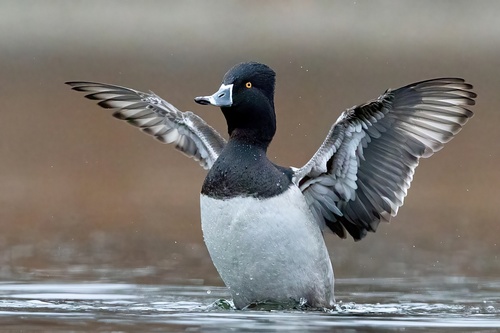
The genus Aythya contains the diving ducks, commonly known as scaups, pochards, and canvasbacks. Unlike dabbling ducks, these hardy waterfowl are built for deep water, often congregating in massive flocks called rafts on large lakes, estuaries, and coastal bays. They are powerful swimmers and expert divers, plunging deep beneath the surface to forage for aquatic plants, mollusks, and insects. Their broad, heavy bills and densely packed feathers are perfectly adapted for a life spent on the move across expansive waterways. Globally distributed, these birds are highly migratory, navigating vast flyways during autumn and spring. Watching a raft of scaups or pochards dive in near-perfect synchronization is one of the most spectacular sights of winter birdwatching.
Lebensraum: Found on large, deep freshwater lakes, slow-moving rivers, brackish estuaries, and sheltered coastal bays.
Rounded heads, sloping bills, and stocky bodies are characteristic of this group. Males often showcase striking patterns of black, white, gray, or rich chestnut-red on their heads and breasts, whereas females exhibit drabber, cryptically colored brown plumages for nesting camouflage. Their wings feature a prominent pale stripe, visible in flight, and their large webbed feet are positioned far back on the body, which aids in powerful swimming but makes walking on land awkward.
Kategorie
VögelSeltenheit
Common
Gefahr
1/5 · Sehr gering
Snaps
Mach den ersten Snap!
Diving ducks like scaups and pochards cannot easily take off directly from the water's surface; instead, they must run across the water to build up enough speed for flight.
Some species of Aythya are known to practice brood parasitism, laying their eggs in the nests of other duck species to be raised by unsuspecting foster parents.
The Canvasback (Aythya valisineria) has a scientific species name derived from its favorite food, wild celery (Vallisneria americana).
To stay warm in freezing winter waters, these ducks compress their feathers to trap a thin layer of insulating air against their skin, which also helps control their buoyancy.
Dense bones and heavy plumage reduce buoyancy, allowing these ducks to dive easily to depths of up to six meters.
Specialized supraorbital glands filter excess salt from brackish water, enabling them to winter in coastal marine bays.
Compact wings and powerful pectoral muscles allow them to achieve exceptionally fast, direct flight during long-distance migrations.
Diving ducks in this genus primarily feed by submerging completely, consuming aquatic plants, seeds, mollusks, insects, and small fish.
Altersunterschiede: Ducklings eat mostly insects and aquatic invertebrates for high protein, transitioning to more plant matter as they mature.
Vulpes vulpes
Foxes prey upon nesting females, ducklings, and eggs in shoreline nests.
Dreissena polymorpha
Scaups and pochards dive deep to forage on these invasive bivalves, helping control their populations.
Fulica atra
Competes for food resources like submerged vegetation and macroinvertebrates in shared wetland habitats.
Für dieses Objekt sind noch keine Merkmal-Badges vergeben.
Noch keine Alternativnamen vorhanden.
Sammlungen für dieses Objekt erscheinen hier, wenn weitere Themen hinzugefügt werden.
Gefahr
1/5 · Sehr gering
Noch keine besonderen Sicherheitshinweise.
Der einfachste Weg, Scaups, Pochards, And Allies zu bestimmen, ist die Verwendung der Naturführer-App Snappit.
38-56 cm
60-85 cm
0.5-1.6 kg
10-22 Jahre
110 km/h
Diving ducks in this genus primarily feed by submerging completely, consuming aquatic plants, seeds, mollusks, insects, and small fish.
Found on large, deep freshwater lakes, slow-moving rivers, brackish estuaries, and sheltered coastal bays.
Zoome hinein, um Cluster aufzulösen und zu sehen, wo dieses Objekt fotografiert wurde.
Neueste Snaps erscheinen hier, wenn neue Beobachtungen hinzukommen.