

Scissor Grinder
neotibicen pruinosus
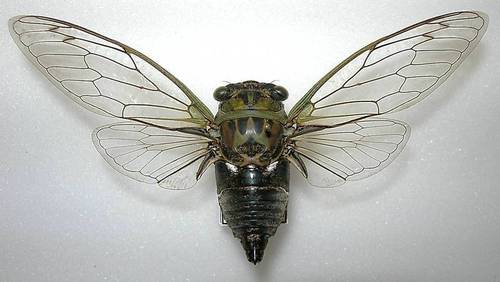
The Scissor Grinder (Neotibicen pruinosus) is a large, distinctive annual cicada famous for producing one of the most recognizable sounds of late summer in the central and eastern United States. Named for its pulsating, metallic call that supposedly resembles the sound of an old-fashioned grinding wheel sharpening scissors, this insect's song is a quintessential acoustic backdrop to hot, humid afternoons. Like other 'dog-day' cicadas, they are often heard but rarely seen, camouflaging perfectly against the bark of hardwood trees. Although they are called 'annual' cicadas because adults emerge every year, the Scissor Grinder actually has a multi-year life cycle. The nymphs spend roughly three years underground feeding on the sap of tree roots before emerging en masse to molt, mate, and start the cycle anew. Their synchronized, albeit overlapping, generations ensure that their unique buzzing chorus remains a reliable summer phenomenon.
Lebensraum: Found in deciduous hardwood forests, open woodlands, suburban parks, and residential neighborhoods, heavily relying on mature trees.
The Scissor Grinder is a robust insect, measuring approximately 4 to 5 centimeters in length, with large, prominent, wide-set eyes and a stocky body. Its coloration is a striking mix of green, black, and brown, heavily patterned on the thorax to blend in with tree bark. One of its most identifying features is the white, powdery, waxy coating—called 'pruinosity'—that covers the sides of its abdomen, giving it a frosted appearance. It has clear, membranous wings that fold tent-like over its back, displaying distinctive green wing veins near the base.
Kategorie
InsektenSeltenheit
Common
Gefahr
1/5 · Sehr gering
Snaps
Mach den ersten Snap!
The Scissor Grinder gets its common name because its rhythmic, pulsating song sounds exactly like an antique foot-pedal grinding wheel sharpening a pair of scissors.
The specific epithet 'pruinosus' refers to the powdery, frosted white wax on the insect's abdomen, which helps it repel water and deter predators.
To cool down on extremely hot summer days, these cicadas literally 'sweat' by extruding excess water collected from their tree sap diet out through their pores.
While they emerge every single year, individual Scissor Grinder cicadas actually spend roughly 3 years living entirely underground as nymphs.
Males possess specialized ribbed organs on their abdomens called tymbals, which buckle rapidly to produce an incredibly loud, pulsating mating call.
Equipped with a sturdy, beak-like proboscis, this cicada can pierce tough tree bark and roots to extract nutrient-poor, watery xylem fluid under high pressure.
The intricate green, black, and brown patterns on their thorax and wings act as disruptive coloration, perfectly blending them into the bark of deciduous trees.
Both nymphs and adults feed exclusively on xylem sap extracted from various hardwood trees.
Altersunterschiede: Nymphs feed on underground tree roots, while adult cicadas feed on the branches and twigs in the canopy.
Sphecius speciosus
Cicada killer wasps actively hunt adult cicadas to paralyze them and use them as a living food source for their larvae.
Quercus alba
Many hardwood tree species serve as the primary food source and breeding ground for nymphs and adults.
Cyanocitta cristata
Birds frequently catch and eat adult cicadas during their summer emergence.
Für dieses Objekt sind noch keine Merkmal-Badges vergeben.
Noch keine Alternativnamen vorhanden.
Sammlungen für dieses Objekt erscheinen hier, wenn weitere Themen hinzugefügt werden.
Gefahr
1/5 · Sehr gering
Noch keine besonderen Sicherheitshinweise.
Der einfachste Weg, Scissor Grinder zu bestimmen, ist die Verwendung der Naturführer-App Snappit.
4-5 cm
7-10 cm
0.001-0.003 kg
2-3 Jahre
Both nymphs and adults feed exclusively on xylem sap extracted from various hardwood trees.
Found in deciduous hardwood forests, open woodlands, suburban parks, and residential neighborhoods, heavily relying on mature trees.
Foraging
Zoome hinein, um Cluster aufzulösen und zu sehen, wo dieses Objekt fotografiert wurde.
Neueste Snaps erscheinen hier, wenn neue Beobachtungen hinzukommen.

Illinois, US
Hier kann man sehen Weißer Maulbeerbaum, Hausgimpel und Scissor Grinder.
Führer anzeigen →

Nebraska, US
Hier kann man sehen Wanderdrossel und Zürgelbaum-Warzengallenlaus.
Führer anzeigen →
















