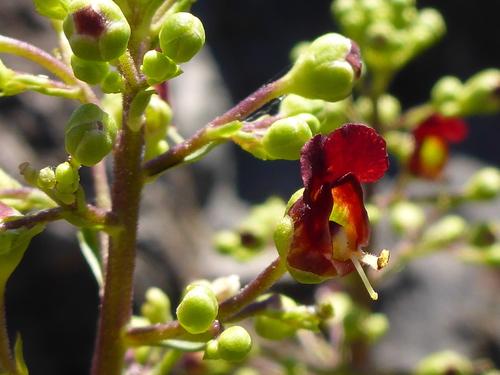


Scrophularia Glabrata
scrophularia glabrata
Scrophularia glabrata, commonly known as Hairless Figwort or Smooth Figwort, is a fascinating perennial herbaceous plant belonging to the figwort family. This species is often overlooked due to its subtle appearance, yet it plays an important role in its native ecosystems. Renowned for its smooth, hairless stems and distinctive flowers, it thrives in moist, often disturbed habitats. The plant's modest charm lies in its resilience and its contribution to local biodiversity, providing nectar for various insects and acting as a host for certain specialized insect species. Its presence often indicates a healthy, undisturbed moist soil environment, making it an interesting indicator species for botanists and naturalists alike. Despite its humble stature, Scrophularia glabrata embodies the intricate beauty and ecological importance found within the plant kingdom.
Lebensraum: This species is typically found in moist, often disturbed areas such as streambanks, wet meadows, ditches, forest edges, and damp clearings with rich, loamy soil.
Scrophularia glabrata typically grows to a height of 40-120 cm with stout, square-ish, and entirely hairless (glabrous) stems that often branch. Its leaves are oppositely arranged, ovate to lanceolate in shape, with serrated margins, and are also notably smooth. The flowers are small and inconspicuous, often greenish-brown to dull purplish, with a unique two-lipped structure. They are arranged in loose, terminal panicles or cymes atop the stems, providing a subtle burst of color amidst the foliage. The plant's overall appearance is often described as robust and unassuming, with a sturdy green presence in its preferred habitat.
Kategorie
PflanzenSeltenheit
Common
Gefahr
1/5 · Sehr gering
Snaps
Mach den ersten Snap!
Despite its common name 'Figwort', the flowers do not resemble figs and the name is thought to derive from a historical belief that the plant could cure 'fig-like' ailments.
Its seemingly insignificant flowers produce a subtle, musky scent that is attractive to specialized pollinators, often different from those that visit more showy flowers.
Some species of Scrophularia, including related ones, have been historically used in traditional medicine for their emetic and purgative properties, though caution is always advised.
The square-shaped stems are a distinctive feature, providing structural rigidity and aiding in identification among other herbaceous plants.
Scrophularia glabrata produces bitter-tasting iridoid glycosides, which act as a natural defense mechanism against generalist herbivores, deterring them from feeding on its foliage.
The unique morphology and subtle coloration of its flowers are specifically adapted to attract small, specialized insect pollinators, such as certain species of bees and wasps, facilitating efficient cross-pollination.
The plant produces numerous small, dark seeds within capsules that, upon ripening, split open to release the seeds. These seeds are adapted for dispersal by wind or water, allowing the plant to colonize new suitable habitats effectively.
As an autotroph, Scrophularia glabrata produces its own food through the process of photosynthesis, utilizing sunlight, water, and carbon dioxide. It absorbs essential minerals and nutrients from the soil.
Bombus spp.
Pollinator, attracted to nectar and pollen.
Cornu aspersum
Herbivore, feeds on leaves and stems.
Various fungal species
Symbiotic relationship, aids in nutrient absorption for the plant.
Tenthredo scrophulariae
Potential larval host for specific insect species.
Für dieses Objekt sind noch keine Merkmal-Badges vergeben.
Noch keine Alternativnamen vorhanden.
Sammlungen für dieses Objekt erscheinen hier, wenn weitere Themen hinzugefügt werden.
Gefahr
1/5 · Sehr gering
Noch keine besonderen Sicherheitshinweise.
Der einfachste Weg, Scrophularia Glabrata zu bestimmen, ist die Verwendung der Naturführer-App Snappit.
40-120 cm
0.3-1.5 kg
2-5 Jahre
As an autotroph, Scrophularia glabrata produces its own food through the process of photosynthesis, utilizing sunlight, water, and carbon dioxide. It absorbs essential minerals and nutrients from the soil.
This species is typically found in moist, often disturbed areas such as streambanks, wet meadows, ditches, forest edges, and damp clearings with rich, loamy soil.
Photosynthesis And Nutrient Absorption
1000-10000
Zoome hinein, um Cluster aufzulösen und zu sehen, wo dieses Objekt fotografiert wurde.
Neueste Snaps erscheinen hier, wenn neue Beobachtungen hinzukommen.









