

Sea Almond
terminalia catappa
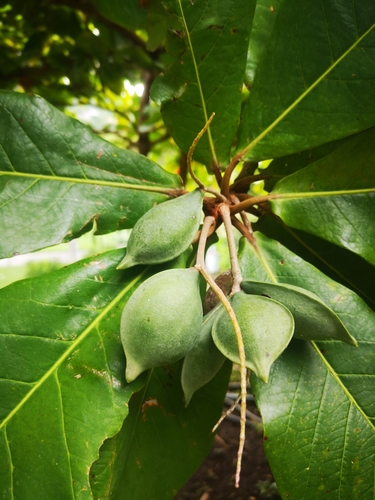
The Sea Almond, also known as the Indian Almond or Tropical Almond, is a magnificent coastal tree renowned for its horizontal, pagoda-like branching structure and large, lush canopy. Thriving naturally near saltwater environments, this versatile tree is famous for its large, leathery leaves that turn brilliant shades of red, copper, and gold before shedding. Beyond its aesthetic appeal, it plays a vital ecological role by preventing coastal erosion and offering shade and nesting sites for various tropical wildlife. Its corky, buoyant fruits are expertly adapted to float across ocean currents, allowing this resilient tree to colonize tropical coastlines across the globe.
Lebensraum: Found primarily along tropical sandy beaches, rocky shorelines, coastal estuaries, and widely cultivated in urban parks and gardens.
This medium-to-large tree typically reaches heights of 15 to 35 meters, characterized by a distinct layered branching pattern that grows horizontally from a single upright trunk. Its broad, obovate leaves are glossy dark green, measuring 15 to 25 centimeters long, and conspicuously turn vibrant red, orange, or yellow during dry or cool seasons. The tree produces small, star-shaped, greenish-white flowers clustered on spikes, which eventually develop into almond-shaped, flattened green drupes that mature to yellow or reddish-purple and contain a fibrous, corky outer shell.
Kategorie
PflanzenSeltenheit
Common
Gefahr
1/5 · Sehr gering
Snaps
Mach den ersten Snap!
Because its branches grow in distinct horizontal tiers resembling a pagoda, it is sometimes referred to as the 'Pagoda Tree' in some regions of East Asia.
Its internal seed kernels are entirely edible and taste remarkably like commercial almonds, though extracting them from the tough, woody fibrous husk requires significant effort.
The fallen leaves of the Sea Almond contain rich tannins and humic acids, and are highly sought after by aquarium hobbyists to naturally condition water and promote healing in delicate fish like Bettas.
The tree produces fruits with a light, corky, and water-resistant outer husk that traps air, allowing them to float on ocean currents for months to colonize new shorelines.
It features thick, waxy leaves and a highly resilient bark structure that withstands harsh salt-laden winds and high-salinity soils.
Its fallen leaves release rich tannins and humic acids into the surrounding soil, which helps inhibit the growth of competing plant species.
As a photosynthetic plant, the Sea Almond produces its own sugars and energy using sunlight, carbon dioxide, water, and essential soil minerals.
Cynopterus brachyotis
The Lesser Short-nosed Fruit Bat feeds on the fibrous outer husk of the ripe fruit, carrying the seed away and dispersing it.
Attacus atlas
The caterpillars of the massive Atlas Moth utilize the large, nutrient-rich leaves of the Sea Almond as a primary food source.
Für dieses Objekt sind noch keine Merkmal-Badges vergeben.
Noch keine Alternativnamen vorhanden.
Sammlungen für dieses Objekt erscheinen hier, wenn weitere Themen hinzugefügt werden.
Gefahr
1/5 · Sehr gering
Noch keine besonderen Sicherheitshinweise.
Der einfachste Weg, Sea Almond zu bestimmen, ist die Verwendung der Naturführer-App Snappit.
1500-3500 cm
50-100 Jahre
As a photosynthetic plant, the Sea Almond produces its own sugars and energy using sunlight, carbon dioxide, water, and essential soil minerals.
Found primarily along tropical sandy beaches, rocky shorelines, coastal estuaries, and widely cultivated in urban parks and gardens.
Photosynthesis
30-90 Tage
Zoome hinein, um Cluster aufzulösen und zu sehen, wo dieses Objekt fotografiert wurde.
Neueste Snaps erscheinen hier, wenn neue Beobachtungen hinzukommen.

Hawaii, US
Hier kann man sehen Hawaiian Garden Spider, Beach Naupaka und Black Noddy.
Führer anzeigen →

Hawaii, US
Hier kann man sehen Yellow ʻilima, Indian Tulip Tree und Zitronendoktorfisch.
Führer anzeigen →