






Shag-Rug Nudibranch
aeolidia papillosa
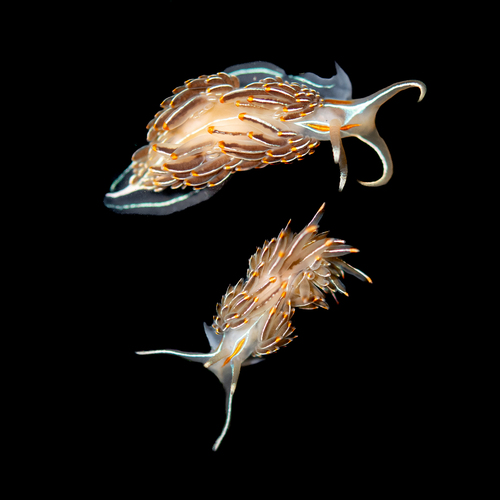
The Shag-Rug Nudibranch looks like a colorful, squishy carpet under the sea! Its vibrant colors and unique shape make it a fascinating creature to spot while exploring tide pools.
Lebensraum: Shag-Rug Nudibranchs live in coastal waters, often hiding among rocks and seaweed.
The Shag-Rug Nudibranch has a soft, oval body covered in numerous fluffy, finger-like projections called cerata, resembling a shaggy rug. It typically displays a cream to pale brown body with white-tipped cerata, making it blend well with its environment.
Kategorie
InvertebrateSeltenheit
Common
Gefahr
1/5 · Sehr gering
Snaps
Mach den ersten Snap!
A Shag-Rug Nudibranch is a hermaphrodite, meaning each individual has both male and female reproductive parts.
Nudibranchs don't have a shell to protect them like snails; they rely on other cool defenses!
These sea slugs breathe through feathery gills on their back, not through lungs like us!
They lay their eggs in beautiful, spiral ribbons that attach to rocks or seaweed underwater.
Shag-Rug Nudibranch can steal stinging cells from its prey because of specialized sacs that help them defend against predators.
Shag-Rug Nudibranch can regrow lost or damaged parts of its body, including its cerata, helping them recover from attacks.
Shag-Rug Nudibranch can safely graze on stinging sea anemones because its skin is immune to their venom.
This sea slug is a carnivore that dines exclusively on stinging sea anemones!
Actinia equina
Its primary food source, providing defense cells.
Metridium senile
Common prey, found grazing on these in cooler waters.

Pycnopodia helianthoides
A large predator of various nudibranchs and invertebrates.
Anarhichas lupus
A bottom-feeding fish known to prey on sea slugs.
Einzelgänger leben den größten Teil ihres Lebens allein und interagieren mit Artgenossen nur zur Paarung oder zur Aufzucht der Jungen.
Farbenfroh beschreibt Organismen oder Objekte, die eine große Vielfalt an leuchtenden und deutlich erkennbaren Farben aufweisen.
Dieses Merkmal kennzeichnet Organismen, deren Ernährung vollständig oder hauptsächlich aus tierischem Gewebe besteht.
Aquatische Lebensräume umfassen Umgebungen, in denen Organismen überwiegend im Wasser leben, darunter Ozeane, Flüsse, Seen und Feuchtgebiete.

Marine Lebensräume umfassen alle Salzwasserumgebungen der Ozeane der Erde und beherbergen eine immense Vielfalt an Wasserlebewesen.
Gefahr
1/5 · Sehr gering
Noch keine besonderen Sicherheitshinweise.
6 cm
5 g
0.5 Jahre
This sea slug is a carnivore that dines exclusively on stinging sea anemones!
Shag-Rug Nudibranchs live in coastal waters, often hiding among rocks and seaweed.
Grazing
25 m
Zoome hinein, um Cluster aufzulösen und zu sehen, wo dieses Objekt fotografiert wurde.
Neueste Snaps erscheinen hier, wenn neue Beobachtungen hinzukommen.











.jpg&width=800)


