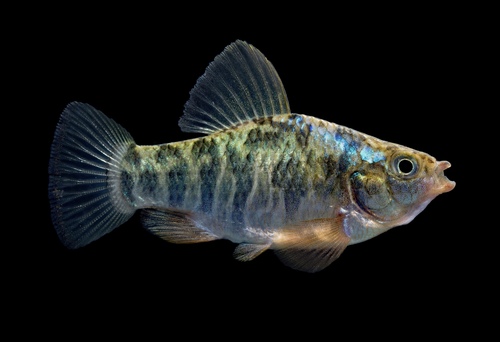


Sheepshead Minnow
cyprinodon variegatus
The Sheepshead Minnow (Cyprinodon variegatus) is a small, highly resilient pupfish native to the salt marshes, estuaries, and coastal lagoons of the western Atlantic Ocean and the Gulf of Mexico. Renowned for its extraordinary environmental tolerance, this tiny fish can thrive in salinity levels ranging from freshwater to hypersaline conditions, and can survive extreme temperature fluctuations that would be fatal to most other fish species. They play a vital role in coastal marine food webs, acting as a crucial link by converting organic detritus and small invertebrates into energy that sustains larger fish and predatory coastal birds.
Lebensraum: Found in shallow coastal waters, including salt marshes, mangrove swamps, estuaries, tide pools, and lagoons with muddy or sandy substrates.
This species features a deep, stout, and compressed body with a distinctively arched back, giving it a somewhat oval or diamond-shaped silhouette. Breeding males display a striking metallic blue or iridescent turquoise color on their napes and backs, paired with a bright orange or yellowish abdomen and matching fins. Non-breeding adults and females are more cryptically colored, exhibiting a silvery-gray or olive-brown base with 7 to 10 dark, irregular vertical bars along their sides. They typically reach a modest length of 3 to 8 centimeters.
Kategorie
FischeSeltenheit
Common
Gefahr
1/5 · Sehr gering
Snaps
Mach den ersten Snap!
Because of their hardiness, Sheepshead Minnows are widely used in scientific laboratories to test the safety and toxicological effects of water pollutants.
During the breeding season, male Sheepshead Minnows become incredibly territorial, aggressively defending small patches of sand or mud from any rival males that approach.
They can tolerate water with oxygen levels so low that other fish would suffocate, sometimes gulping air bubbles directly from the surface to survive.
It can effortlessly transition between freshwater and hypersaline environments three times saltier than the ocean without suffering osmotic shock.
This species can survive in shallow, stagnant waters ranging from near-freezing temperatures to over 40 degrees Celsius.
To escape wading birds or aquatic predators, it can rapidly vibrate its body to bury itself beneath mud or sand, leaving only its eyes exposed.
They are highly opportunistic feeders that graze on organic detritus, algae, small crustaceans, and insect larvae.
Egretta thula
The Snowy Egret hunts Sheepshead Minnows in shallow salt marshes and mudflats.
Callinectes sapidus
Blue Crabs ambush and feed on Sheepshead Minnows swimming near muddy bottoms.
Poecilia latipinna
Competes with Sailfin Mollies for food resources like filamentous algae and small aquatic insects in shallow brackish water pools.
Für dieses Objekt sind noch keine Merkmal-Badges vergeben.
Noch keine Alternativnamen vorhanden.
Sammlungen für dieses Objekt erscheinen hier, wenn weitere Themen hinzugefügt werden.
Gefahr
1/5 · Sehr gering
Noch keine besonderen Sicherheitshinweise.
Der einfachste Weg, Sheepshead Minnow zu bestimmen, ist die Verwendung der Naturführer-App Snappit.
3-8 cm
0.002-0.01 kg
1-3 Jahre
4 km/h
They are highly opportunistic feeders that graze on organic detritus, algae, small crustaceans, and insect larvae.
Found in shallow coastal waters, including salt marshes, mangrove swamps, estuaries, tide pools, and lagoons with muddy or sandy substrates.
Foraging And Grazing On Substrates And Plants For Food Particles And Microorganisms Without Active Pursuit Tactics Used By Predators For Prey Capture Methods Instead Scraping Algal Mats With Teeth And Snapping At Passing Zooplankton In The Water Column Or Muddy Sand Substrates Of Estuaries And Salt Marshes Alike As They Move About Actively During Daylight Hours Along Shallows Near Coastlines Of The Gulf And Atlantic Coasts Of North America With High Efficiency Levels Overall In All Life Stages Including Larval Stages Too Which Feed Mostly On Zooplankton And Microscopic Algal Blooms In The Same Habitats As Adults Though At Smaller Scales Of Prey Items And Particles Primarily Due To Mouth Size Limitations And Physical Capabilities Which Develop Rapidly After Hatching From Eggs Laid In Shallow Gravelly Or Sandy Nest Sites Created By Territorial Males Protecting Their Areas Fiercely From Intruders While Displaying Vibrant Breeding Colorations To Attract Receptive Females During The Warmer Months Of Spring And Summer Periods Of High Activity And Reproduction Cycles Occurring Regularly Throughout The Season In Various Coastal Regions Where Populations Are Widely Distributed And Stable Overall Without Major Threats To Their Continued Survival And Abundant Existence In Healthy Wetland Ecosystems That Provide Ample Food And Shelter From Larger Predators Of The Open Water Habitats Nearby
Zoome hinein, um Cluster aufzulösen und zu sehen, wo dieses Objekt fotografiert wurde.
Neueste Snaps erscheinen hier, wenn neue Beobachtungen hinzukommen.














_01.jpg&width=800)


