

Siberian Crabapple
malus baccata
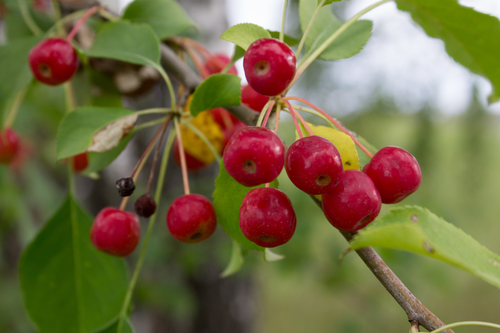
The Siberian Crabapple (Malus baccata) is a remarkably hardy, deciduous tree native to the cold regions of northeastern Asia, including Siberia, China, and Korea. Renowned for its spectacular spring display, this tree bursts into a cloud of fragrant white or pale pink blossoms that attract a plethora of early pollinators. In the autumn, it produces abundant, small, pea-sized red or yellow ornamental fruits that persist long into winter. This species is highly valued not only for its ornamental beauty and extreme frost tolerance but also as a sturdy rootstock for grafting cultivated apple varieties. It plays an important role in its native ecosystems, offering vital sustenance to various bird and mammal species during the harshest months of the year.
Lebensraum: Typically found in mixed forests, valley thickets, and along riverbanks up to high elevations in cold-temperate regions.
This medium-sized tree typically grows up to 10 to 14 meters in height, featuring a rounded, spreading crown with slender, arching branches. In spring, it is adorned with clusters of five-petaled white flowers, approximately 3 to 3.5 centimeters across. The leaves are ovate or elliptic, dark glossy green with finely serrated margins, turning yellow or red in autumn. Its fruits are distinctively tiny, globose, and berry-like, measuring only 1 centimeter in diameter, hanging from long, slender pedicels in shades of vibrant red or yellow.
Kategorie
PflanzenSeltenheit
Common
Gefahr
1/5 · Sehr gering
Snaps
Mach den ersten Snap!
Because of its incredible cold hardiness, it is widely used in apple breeding programs to introduce frost resistance to commercial apple cultivars.
The specific epithet 'baccata' is Latin for 'berry-like', referring to its exceptionally small, cherry-sized crabapples.
The tart fruits can be harvested to make jellies and preserves, which develop a rich, ruby-red color when cooked.
It can withstand temperatures as low as -45 degrees Celsius, making it one of the hardiest of all apple species.
The tiny crabapples cling tightly to the branches through heavy snows, providing a reliable winter food source for wildlife.
Its vigorous root system efficiently absorbs nutrients from poor soils and displays exceptional resistance to common root pathogens.
As a photoautotroph, the Siberian Crabapple produces its own food through photosynthesis, utilizing sunlight, carbon dioxide, water, and essential soil minerals.
Bombycilla cedrorum
The Cedar Waxwing feeds extensively on the persistent winter fruits of the Siberian Crabapple, helping disperse its seeds.
Apis mellifera
Honeybees are primary pollinators of the blossoms during the spring, gathering nectar and pollen.
Cydia pomonella
Larvae of the Codling Moth feed on the developing crabapple fruit, causing internal damage.
Für dieses Objekt sind noch keine Merkmal-Badges vergeben.
Noch keine Alternativnamen vorhanden.
Sammlungen für dieses Objekt erscheinen hier, wenn weitere Themen hinzugefügt werden.
Gefahr
1/5 · Sehr gering
Noch keine besonderen Sicherheitshinweise.
Der einfachste Weg, Siberian Crabapple zu bestimmen, ist die Verwendung der Naturführer-App Snappit.
500-1400 cm
50-100 Jahre
As a photoautotroph, the Siberian Crabapple produces its own food through photosynthesis, utilizing sunlight, carbon dioxide, water, and essential soil minerals.
Typically found in mixed forests, valley thickets, and along riverbanks up to high elevations in cold-temperate regions.
Zoome hinein, um Cluster aufzulösen und zu sehen, wo dieses Objekt fotografiert wurde.
Neueste Snaps erscheinen hier, wenn neue Beobachtungen hinzukommen.