

Silverleaf Oak
quercus hypoleucoides
The Silverleaf Oak (Quercus hypoleucoides) is a striking evergreen tree or large shrub native to the mountainous regions of the Southwestern United States and northern Mexico. Known for its remarkable leaf coloration, this oak stands out in its rugged habitat of pine-oak woodlands, canyons, and dry slopes. It plays a critical ecological role in montane ecosystems, providing crucial food and nesting sites for regional wildlife, while its robust root systems help stabilize rocky soils.
Lebensraum: Typically found in montane pine-oak woodlands, canyons, and rocky slopes at elevations between 1,500 and 2,700 meters.
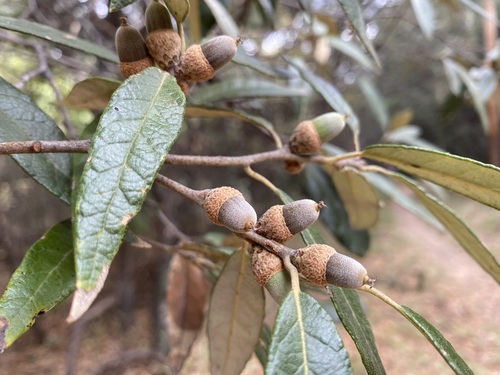
This evergreen oak typically grows to heights of 5 to 10 meters, though it can occasionally form a taller tree. Its most diagnostic feature is the lance-shaped, leathery leaves which are glossy dark green on the upper surface and covered in a dense, woolly layer of white-to-silvery hairs underneath. The contrast is highly visible when the wind blows, making the canopy appear to shimmer. Its bark is dark gray and deeply furrowed, and it produces small, slender, dark brown acorns with puberulous caps.
Kategorie
PflanzenSeltenheit
Common
Gefahr
1/5 · Sehr gering
Snaps
Mach den ersten Snap!
Because of their attractive bicolored foliage, they are occasionally cultivated in Southwestern botanical gardens and xeriscapes as shade trees.
Its evergreen nature means it retains its leaves throughout the winter, providing critical green shelter and forage for wildlife when other deciduous trees are bare.
The scientific species name 'hypoleucoides' translates from Greek to mean 'white beneath', directly referencing the striking silvery undersides of its leaves.
The dense layer of white trichomes on the underside of the leaves reflects intense solar radiation and reduces moisture loss by trapping a boundary layer of humid air.
It possesses a vigorous underground root crown that allows the tree to rapidly sprout new shoots even if the aboveground foliage is entirely consumed by wildfire.
Its deep taproot system can penetrate cracks in rocky substrate to access deep moisture reserves during dry desert seasons.
The Silverleaf Oak is a photoautotrophic plant that generates its own organic energy via photosynthesis using sunlight, water, carbon dioxide, and essential nutrients absorbed through its root system.
Adelpha eulalia
The larvae of this butterfly feed on the leaves of the oak.
Melanerpes formicivorus
Harvests and stores the acorns of the silverleaf oak as a primary winter food source.
Odocoileus virginianus
Browses on the young shoots, leaves, and acorns of the tree.
Für dieses Objekt sind noch keine Merkmal-Badges vergeben.
Noch keine Alternativnamen vorhanden.
Sammlungen für dieses Objekt erscheinen hier, wenn weitere Themen hinzugefügt werden.
Gefahr
1/5 · Sehr gering
Noch keine besonderen Sicherheitshinweise.
Der einfachste Weg, Silverleaf Oak zu bestimmen, ist die Verwendung der Naturführer-App Snappit.
300-1500 cm
80-200 Jahre
The Silverleaf Oak is a photoautotrophic plant that generates its own organic energy via photosynthesis using sunlight, water, carbon dioxide, and essential nutrients absorbed through its root system.
Typically found in montane pine-oak woodlands, canyons, and rocky slopes at elevations between 1,500 and 2,700 meters.
Zoome hinein, um Cluster aufzulösen und zu sehen, wo dieses Objekt fotografiert wurde.
Neueste Snaps erscheinen hier, wenn neue Beobachtungen hinzukommen.



















